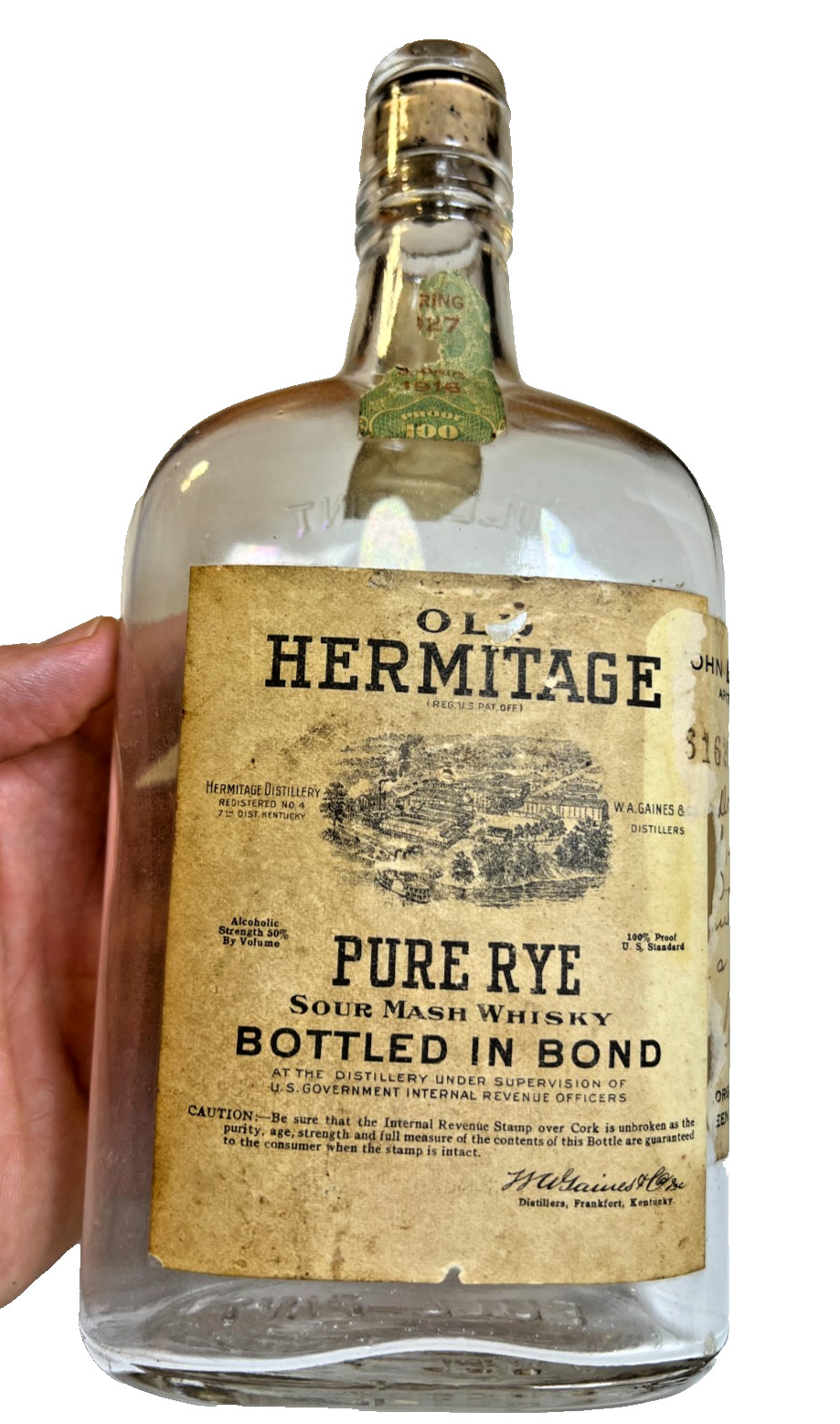
Antique Hermitage Whiskey Bottle Bond Prohibition Tax Prescription Frankfort, KY

When you click on links to various merchants on this site and make a purchase, this can result in this site earning a commission. Affiliate programs and affiliations include, but are not limited to, the eBay Partner Network.

Antique Hermitage Whiskey Bottle Bond Prohibition Tax Prescription Frankfort, KY:
$1780.25
This is a once-in-a-generation survival of an American whiskey bottle that lived two legal lives. Bottled in bond in 1916 by W. A. Gaines & Co. of Frankfort, Kentucky, this Old Hermitage Pure Rye retains its original glass stopper with cork liner, intact green Internal Revenue tax strip, original distillery labels, and a handwritten Prohibition-era medical prescription dated 1928. Most bottles from this period lost one of these elements. This one lost none.
OLD HERMITAGE PURE RYE WHISKEYBottled in Bond · Medicinal Era · Complete Original Survival
Frankfort, Kentucky → Staten Island, New York | 1916–1928
Why this bottle mattersThis bottle is not rare because it is old.
It is rare because every fragile, usually-lost element survived together, and because it documents two separate legal eras of American alcohol history in a single object.
Most bottles are containers.
This one is a paper trail in glass.
It carries:
Pre-Prohibition federal regulation
Bottled-in-Bond law
The rise of industrial American whiskey
The political and moral forces that caused Prohibition
And the loophole that quietly kept whiskey alive through medicine
That combination — intact, original, documented — is why this is a museum quality bottle.
Precise datingLet’s pin this down tightly, because the bottle itself gives us the receipts.
1. The green Internal Revenue tax stripThe green strip on the neck is a federal Internal Revenue strip stamp, applied at the time of bottling.
Marked “Spring 1916”
Indicates 100 proof
Confirms federal tax paid
Guarantees purity, age, and strength
These stamps were issued only before Prohibition and were legally required to be destroyed when the bottle was opened.
The presence of this stamp — intact and original — means:
The whiskey was bottled circa 1916
Under direct U.S. government supervision
Before national alcohol prohibition existed
This alone firmly dates the bottle to 1916–1917.
2. The reverse label (this seals it)The back label states:
“MADE PRIOR TO SEPT. 8, 1917”
That date is critical.
September 8, 1917 marks the Wartime Prohibition Act, the first major federal restriction on alcohol production during World War I.
This wording was used only during a brief transitional window, when distillers needed to certify that whiskey had been produced before wartime restrictions.
This narrows the bottling window to:
Late 1916 – early 1917
That is razor-sharp dating for a whiskey bottle.
The front label — what it tells usThe primary label reads:
OLD HERMITAGE
PURE RYE
SOUR MASH WHISKEY
BOTTLED IN BOND
100 PROOF
This label tells us several important things:
“Bottled in Bond”This refers to the Bottled-in-Bond Act of 1897, America’s first consumer protection law.
To use this phrase, the whiskey had to:
Be distilled at one distillery
In one distilling season
Aged at least four years
Stored in a federally bonded warehouse
Bottled at exactly 100 proof
Under continuous government supervision
In short: this was elite, regulated whiskey, not back-alley hooch.
W. A. Gaines & Co., Frankfort, KentuckyGaines was one of Kentucky’s serious distillers — not a fly-by-night operation.
Old Hermitage was marketed as:
Refined
Reliable
This was upper-tier rye, the kind consumed by professionals, businessmen, and physicians — not moonshiners.
The glass stopper with cork linerThe original glass stopper with cork liner is still present.
This is one of the rarest survivals.
Why?
Glass stoppers were fragile
Cork liners dried out
Most were replaced, discarded, or broken
During Prohibition, bottles were often opened, reused, and resealed with whatever was available
Having the original fitted stopper means:
The bottle was handled carefully
It was not aggressively reused
It avoided decades of casual destruction
In museum terms: this is a primary survival component, not an accessory.
The prescription label — Prohibition in handwritingNow we enter the second life of the bottle.
On the side is an original apothecary label from:
John E. Grady, Apothecary
Staten Island, New YorkWith a handwritten prescription dated:
August 11, 1928
This is not decorative.
Why whiskey prescriptions existed
This is legal documentation.Prohibition (1920–1933) did not ban alcohol outright.
It banned recreational alcohol.Medicinal alcohol remained legal.
Doctors could prescribe:
Whiskey
Brandy
Wine
For:
“Nervous disorders”
Digestive issues
Pain
Insomnia
General “weakness”
Pharmacies dispensed it, and bottles were often refilled and relabeled, exactly as seen here.
This bottle proves:
It survived Prohibition intact
It was legally dispensed again
It remained valuable enough to keep, not discard
This is documented Prohibition sidestepping, not rumor.
Why Prohibition happenedProhibition wasn’t sudden. It brewed for decades.
Forces at work:Industrialization (urban poverty & alcoholism)
Religious temperance movements
Women’s suffrage activism
Wartime grain conservation
Anti-immigrant sentiment (beer = German, whiskey = Irish)
By World War I, alcohol was framed as:
Unpatriotic
Wasteful
Morally corrupt
The result:
Wartime bans → Volstead Act → 18th Amendment
Ironically, this increased the value of legitimate pre-Prohibition whiskey — especially bottled-in-bond stock already in warehouses.
Your bottle sits right at that pressure point.
Technology, medicine & daily life (1916–1928)TechnologyElectricity spreading, but not universal
Early automobiles replacing horses
Telegraphs and telephones expanding
Bottled products becoming standardized and branded
No antibiotics
Whiskey used as:
Pain relief
Sedative
Digestive aid
Pharmacies were community hubs, not chain stores
Men in suits, women in long skirts (then flappers)
World War I → Roaring Twenties
Speakeasies vs prescription pads
Federal law vs local workaround
This bottle lived through all of it.
Why this is a museum bottleThis bottle has:
✔ Pre-Prohibition bottled-in-bond whiskey
✔ Exact federal dating (1916–1917)
✔ Intact Internal Revenue tax strip
✔ Original glass stopper with cork
✔ Original front and reverse labels
✔ Prohibition-era prescription label
✔ Handwritten date and pharmacy provenance
✔ Clean, undamaged glass
Most examples have one or two of these.
This bottle delivers all four.
Rarity ContextOf all empty antique whiskey bottles out there:
~80% have no labels
~15% have partial paper remnants
~5% have legible paper
<1% have complete labels + tax strip + stopper
And an even tinier fraction also have: Prohibition medicinal usage evidence
Antique Hermitage Whiskey Bottle Bond Prohibition Tax Prescription Frankfort, KY:
$1780.25
Related Items:
Antique Hermitage Whiskey Bottle Bond Prohibition Tax Prescription Frankfort, KY
$1780.25
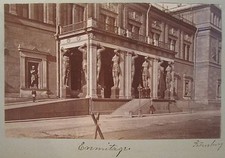
ANTIQUE VICTORIAN NEW HERMITAGE MUSEUM ST PETERSBURG RUSSIA STATUE RARE PHOTO
$499.99
Sinai Byzantium Orthodox Art Hermitage Museum Icons Jewelry Ivories Enamel Coin
$349.99