UNESCO MEMORY OF THE WORLD First Roman Catholic Icon 100AD found Leicester 2016

When you click on links to various merchants on this site and make a purchase, this can result in this site earning a commission. Affiliate programs and affiliations include, but are not limited to, the eBay Partner Network.

UNESCO MEMORY OF THE WORLD First Roman Catholic Icon 100AD found Leicester 2016:
$531354.00
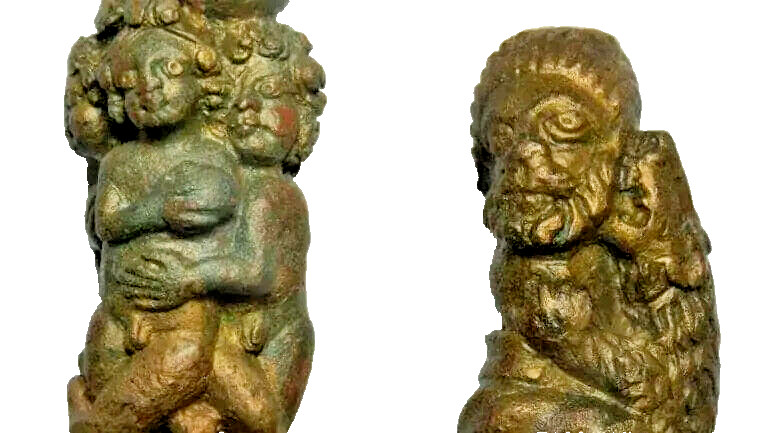
This bronze icon would be an ideal candidate for registry as a UNESCO International Memory Of The World object. Being an icon in 100AD being manufactured at the then known center of the world and transiting or escaping to its very edge - at a time when the world was in fact flat. Leicester's 'Jewry wall' museum, dedicated to 100 Roman finds in the city, was opened this year in July 2025, at the cost of 16.8 million pounds. The centre piece of its' display, and in many ways its 'raisonne d'etre' was to be the unique Roman artefact here described. However, since the publication of this listing on , one year earlier in July 2024, the artefacts' significance to the museum has been relegated in importance with the resultant realisation of it's misattribution at the time of its' discovery and first revelation to the wider world in 2016 -2021. With the attribution corrected as seen here, that 16.8 million pound investment would not be wasted as it is now. Instead, the museum, Leicester, and the artefact, with the correct attribution, would be a centre of pilgrimage for a significant proportion of the world's population.Foreword.We, the authors, would like to thank the funding bodies for the archaeological digs of the University of Leicester, and the University of Cambridge, University of Bristol, the Discovery Television channel through Professor Alice Roberts, The British Museum and The Metropolitan Museum of New York for delivering the above shown artefact (restored over a period of 4 years) into our safe hands, as archaeologists, and facilitating our expert finesse in its' annunciation and transfiguration,reincarnating and elevating it to its position most high, at the very pinnacle of, and value to, the Catholic religion. We do realise that our findings as described here probably re-write and elevate the history of Roman Leicester itself, (including the road which fronted the 'Villa' or location where the artefact itself was found) (itself likely lined with small temples) as the below, new revelations, suggest the building in which the artefact was found likely had a significant religious context - such as an early Christian refuge, reflecting the fact that the not too distant (200 metres) Leicester Cathedral itself, is built upon Roman foundations. We are in our own humble way, as mere servants and messengers, standing on the shoulders of these historical and technical giants of Archaeology.........None of what we write below in any way does justice to the enormity of religious substance which embellishes and encapsulates this particular artefact. However - at its core is the rejuvenation, reincarnation, rebirth, transformation and ultimately the transfiguration of this small piece of copper alloy, (prior believed and described by the above bodies and the world's press, to be representative of human barbarity carried out in Roman Britain - a great slight upon its true purpose and besmirching the contradistinctive intent with which it was imbibed ), into an immensely powerful symbol, and indeed progenitor of no less than the Catholic church itself, simply through the power of the (copyrighted) words below and above.
Unique opportunity -probably of interest particularly to those living in the Vatican;- for sale is this copyright (comprising all the words below and related expressions, written, film, media, artwork or music (with the exception of the Wikipedia note) and not including the copper alloy artefact shown or its' image as described on 'Digging for Britain' TV episode, and in the Journal 'Britannia'("At Death's Door: A Scene ofDamnatio ad Bestiason a Key Handle from Leicester'Britannia 9 Aug 2021") ( an academic paper produced by Cambridge University press which together with the artefact's discoverers effectively re-buried the (now here described)'Icon', through an incorrect description, and a paper which the world's press and media immediately spread globally in 2021).Thus in contradistinction to this description; the"Icon" is defined as such; and seen for the first time here - resurrected in the present copyright from it's burial by archaeologists in 2021 in the above Cambridge University Journal & on 'Digging for Britain TV episode', and is exhumed here from its burial there, and so returned to it's rightful place & primacy as a pillar and founding block, perhaps corner-stone of the Christian and Catholic religion.(please also see our expressive revelation of the true 'Battle of Hastings' and the origin of 'English' in 2 of our other listings as derived from our own discovery of related archaeological finds, which like this copyright also re-write history on a grande scale and at a fundamental level) (noting that the present copyright is effectively an archaeological find which we uncovered from it's re-burial, albeit that we do not possess this particular object [the object itself is not a part of this sale, just our expression of it as an icon of St.Ignatius of Antioch])[We, however, would like to express our gratitude to Cambridge University, the archaeologists from Leicester University, Professor Alice Roberts and her TV team and the Discovery channel etc. and the Metropolitan Museum and British Museum for finding and delivering this artefact to us so that we could utilise our particular skills and expertise in adding and fully extracting value to and from it.] (we estimate that the object itself, merely as an object, - without our here shown copyrighted analysis of it, (and merely being a 'key handle with a representation of Roman barbarity carried out in Britain in c200AD' (incorrectly so described) -would merely be worth about £45,000 - and still is. (in fact - the present description will make the object itself worth much less than it was when it was first found). On its own - it is merely an object without a home, or a context. It is an old decorative piece of bronze. Such a shame for that opportunity to have been wasted. Interestingly, if this object was gold, the situation would unlikely to have arisen, as, upon discovery, under law, it would have had to be reported to the government, as treasure trove, for considered analysis and valuation. Although, despite these tribulations, all this misattribution is corrected in the present copyright, and it's value restored, albeit that somebody is getting a bargain, as the limit for selling on is $1million and the object, if now combined with these words would be absolutely priceless as a tangible pillar of the Roman Catholic religion with a direct connection to Jesus in respect of its historicity (unambiguous historical context).
All the rights to books, media, films and song derived from this unique idea are copyright, and included. This idea is in contradistinction to the idea presented in the above journal & TV program, the Metropolitan and British museums etc., that the artefact there described is evidence of Roman barbarity acted out in Britain and specifically, prior to the present sale, had no specific connection to Ignatius of Antioch. No connection to Ignatius is previously, to the present copyright, made in the description of the artefact. Nor is it's specific importance and physical connection to Christianity elsewhere previously described. If one has any doubts about the value of this copyright; consider that Ignatius was the first to apply the terms 'Catholic' and 'Christianity' to religion. Thus one could reasonably argue that Catholicism would not exist without him. And, importantly, this artefact is the very first depiction of Ignatius of Antioch. One might consider what a contemporary bronze of Jesus on the cross, produced at the site of his execution might be worth.......this is next best, and perhaps only produced a 60 years later. (Consider also the purely hypothetical null hypothesis that there was never somebody called Jesus who was crucified........in which case - this artifact is (paradoxically) THE most important tangible object to Christianity bar none."Wherever the bishop appears, there let the people be, even as wheresoever Christ Jesus is, there is the Catholic Church."
~St. Ignatius
Ignatius' "Epistle to the Smyrnaeans" (written around 100AD) is the first recorded instance of the use of the word "Catholic".
Consider also that Ignatius was considered to have known the Apostles personally and so contemporaneous artifacts connected directly to him might be considered to have a direct material connection to Jesus himself , rather than the mere somewhat speculative words on a manuscript such as those of Mathew, Mark, Luke & John made through the immaterial fog of memory. Thus the artefact shown above,found whilst excavating a Roman villa in Leicester, UK in 2016 (and restored over 4 years), is in fact a Christian Icon which strongly underpins the Christian religion and it's spread throughout and to the limit of the then known world in c110AD. (and to the rest of the world subsequently). Especially because of the situation, context, in which the above 'Icon' was found and it's time of production. This is your chance to own it's reproduction in this context. i.e. as a depiction of (St).Ignatius (of Antioch) or more generally as a representation of the Christian religion or even more generally as a specific religion of any kind related to a man eaten by a lion) (note also that the child is holding an 'orb' (indicating that by Ignatius' martyrdom, Christians would inherit the world (globe) (by analogy, and syncretist with the globe of Jupiter) (and possibly that the 'globe' is used as a metaphor for a 'sphere of human existence' - before it was realised that the world was in fact spheroidal)(and also in Ignatius' own words, those that follow him will become disciples ("Nunc incipio discipulus esse" 'Now begin to be a disciple') - indeed and importantly, perhaps the first indication that it was known that the world was a sphere or globe, even in metaphor (rather than flat))); and as such is the first representation of the orb in the Christian religion - perhaps syncretist with respect to the pagan 'orb' (of Jupiter for example) and being particularly important at the time of production due to the fact that this artefact c110AD -211AD as it appears, geographically at the then 'end of the known world' (limit of the Roman Empire (the empire of man)) at the time of it's production)Note also that in the Roman tradition, St.Ignatius is associated with angels depicted as Putti. See the last 3 images from 1540 onwards showing St.Ignatius with heavenly putti. Also - From Google AI.........""St. Ignatius of Antioch, a prominent figure in the early Church, isassociated with the concept of four angelic "choirs" or "orders" in his writings, specifically in his Letter to the Trallians.While not explicitly detailed as four distinct groups, his reference to angelic beings in a hierarchical structure reflects an understanding of heavenly beings that influenced later theological developments, particularly in Eastern traditions.Here's a more detailed explanation:- Context in Ignatius's Writings:In his Letter to the Trallians, Ignatius mentions "principalities, powers, both earthly and heavenly," suggesting a tiered system of angelic beings.This idea of distinct angelic orders, though not fully developed, laid groundwork for later theological elaborations.
- Influence on Eastern Tradition:This concept of hierarchical angelic orders resonated with Eastern Christian thought, which often emphasizes a structured cosmos with various levels of spiritual beings.While the exact number and nature of these angelic orders varied, the idea of a divinely ordained hierarchy of spiritual beings became a significant aspect of Eastern Christian theology and iconography.
- Distinction from Western Angelology:While the idea of angelic hierarchies is present in Western Christianity as well, particularly in the writings of Pseudo-Dionysius the Areopagite, the specific details and emphases can differ from Eastern interpretations.The emphasis on the liturgical and mystical aspects of angelology in Eastern traditions, influenced by figures like St. Ignatius, can be seen as a distinct contribution.
- Beyond Four Angels:It's important to note that the concept of four specific angelic choirs is not directly stated by Ignatius.His reference is more about the existence of different ranks or orders of angels.The specific grouping into four is a later development within Eastern Christian theology, often drawing inspiration from his writings.
- Liturgical Significance:The idea of angelic choirs, inspired by Ignatius's writings, has also found expression in the liturgical practices of Eastern Orthodox churches, where choirs sing in a responsive or antiphonal manner, mirroring the heavenly worship of angels."...... Furthermore................
- In Eastern Orthodox tradition, the four angels most often associated with St. Ignatius of Antioch are Michael, Gabriel, Raphael, and Uriel.These four are frequently depicted together in art and iconography, especially in mosaics.While St. Ignatius is not directly linked to these four angels in scripture or hagiography, they are commonly associated with him in liturgical and artistic representations, particularly within the Eastern Orthodox Church.The Four Angels are often referred to as the "Four Holy Archangels".Here's a little more about each of them:
- Michael:Often depicted as a warrior, he is known as the leader of the heavenly host and the defender of the faith.
- Gabriel:The messenger of God, known for announcing the Incarnation to the Virgin Mary.
- Raphael:The healer and protector of travelers, often associated with journeys.
- Uriel:The angel of wisdom and prophecy, known for bringing divine light and understanding.
This sale is for the important copyright of the idea that the copper alloy artefact found at a Roman building in Leicester UK, as shown above is in fact a Christian icon of St. Ignatius who was eaten by lions c117AD and thus the artifact is evidence that the event was (by definition) one of the prime drivers of the spread of 'Christianity' throughout the Roman empire. It is thus the first depiction of St Ignatius. Thus the reproduction of the description of the image of the artifact in this context is copyright.as of 04/july/2024; 08.58 am. and at the time of this listing on .Whosoever purchases it will need the financial substance to defend the copyright.
'St. Ignatius was sentenced to death in the Roman Colosseum, to be eaten by lions. He went joyfully to his death around the year 110, with the name of Jesus on his lips and in his heart.
In his letter to the Romans, Saint Ignatius wrote: "Allow me to become food for the wild beasts, through whose means it will be granted me to reach God. I am the wheat of God, and am ground by the teeth of the wild beasts, that I may be found the pure bread of Christ.' This icon depicts his willing martyrdom in the arena.
It would have been a very powerful representation of 'Christianity' in Britain (and from there to the rest of the world), from the time of it's production.
The building where it was found may have been sacked by none-christian (pagan) barbarians or indeed by Septimius Severus (208-211 in Britain) who persecuted Christians. Possibly on the occasion of the British legions leaving to fight Severus legions in Gaul in 197AD and leaving the villa undefended. Hence it was left (and found) on it's own, as a symbol of defiance and of Christianity , which has been resurrected. This isolation within it's context was clearly observed and reported by the archaeologists who found it. Indeed it might and may well have thus originally come from Rome.
(Highly likely evidence of the sack of Leicester by Angles (who worshipped Odin and Isis (as seen in our other listing of a 480 idol) and the establishment of Mercia.) or perhaps more likely a similar earlier event such as the rebellions of the 2nd century led by the Brigantes as described in Wikipedia or indeed by Septimius Severus, who persecuted 'Christians' when he arrived in Britain in 208.
From Wikipedia
Suppressing rebels in Britain[edit]TheHistoria Augustareports that when Hadrian became emperor, he was confronted with a series of rebellions across the empire, which included Britain where "the Britons could not be kept under Roman control".[17]Sheppard Frereputs theBrigantesat the center of the rebellion in Britain, who had close ties to theSelgovaeand theNovantae, in southernCaledonia. Frere notes we lack many of the details of this insurrection, but an inscription fromJarrowand commemorative coins issued in 119 attest to Falco's supposed success in crushing the revolt.[18]A reference by the oratorFrontoto many soldiers being killed in Britannia under Hadrian's rule has been suggested as indicating that the victory was hard-won. However, Fronto may have been referring to a different conflict.
copyright as of 04/july/2024; 08.58 am Peter Reynolds(so other previous interpretations of the artefact are in essence and interpretation, wrong)This sale only includes an A 4 Sheet of paper with the above written on, and appropriately signed; and the new owner will own the copyright of the idea and all the words herein.(and does not include the idol shown in the above picture or the picture of St Ignatius.) Note also the artefact could have been attached to a crucifix as opposed to a 'key' as previously described (copyright)NB the time of this icon might relate to the 'lost legion'IX Hispania, perhaps lost in the same event of its' demise to the Brigantes. All the above perhaps supporting the contention that the artefact was actually produced prior to Ignatius' execution, and for sale as a memento at the amphitheatre or colosseum where it happened. Subsequently brought to Britain soon after. (copyright) Not beyond possibility that in converting its owner to christianity, it was brought to Britain in an attempt to flee the barbarity of Rome and Trajan's persecution. Perhaps that's also why Hadrian came to Britain and why he built Hadrian's wall. (to keep pagans out). To provide an enclave for Christianity as far away from Rome as possible. (copyright) Possibly the artefact itself related to and coming to Britain with the remains of Ignatius. Possibly the iron to which it was attached - the shackles of Ignatius. (all the above being copyright). The makings of an epic film, book, song, music, media etc.
Please note, not to press the Buy It Now in the EU as we are not registered for VAT in any country in the EU, (and monies will be taken directly from your bank account) and also be aware that in the EU stipulate that buyers are liable for all costs related to import. I am guessing that one would not have to pay import duties on a copyright.
Track Page Views With
Auctiva's Counter
UNESCO MEMORY OF THE WORLD First Roman Catholic Icon 100AD found Leicester 2016:
$531354.00
Related Items:
UNESCO MEMORY OF THE WORLD First Roman Catholic Icon 100AD found Leicester 2016
$533210.50
New Zealand 1850s SCHOONER-MANiA - UNESCO MEMORY OF THE WORLD Bezos' boat
$168737.50
(2309) 6-3-2026 - UNESCO - PICS p/c - Japan - Hiroshima Peace Memorial
$3.57