COMPOSER AUTOGRAPHED SCORE SCARCE JEAN RENOIR ORSON WELLES FRENCH PAUL MISRAKI

When you click on links to various merchants on this site and make a purchase, this can result in this site earning a commission. Affiliate programs and affiliations include, but are not limited to, the eBay Partner Network.

COMPOSER AUTOGRAPHED SCORE SCARCE JEAN RENOIR ORSON WELLES FRENCH PAUL MISRAKI:
$5509.05
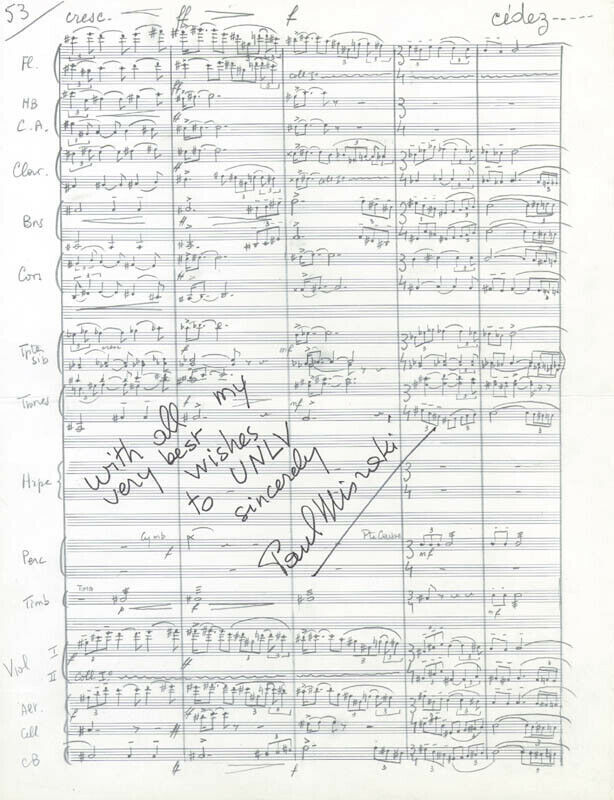
PAUL MISRAKI This musical score in pencil IS ALSO signed by the French composer in black felt tipInscribed Musical Score Signed: "with all my/ very best/ wishes/ to UNLV/ sincerely/ PaulMisraki". 10½x13¾. Front and back of single sheet features a musical score.
Paul Misraki (1908-1998) was born in modern-day Istanbul, Turkey. He fled France with his colleague and friend Jean Renoir during WWII; the pair eventually found themselves in Hollywood, California. Misraki composed the music for many of Renoir's films. He also worked with Yves Allegret, Jean Boyer, and Orson Welles. Slight wear along edges. Light paperclip impressions. Light creasing. Otherwise, fine condition.Over the course of over 60 years, Misraki wrote the music to 130 films, scoring works by directors like Jean Renoir, Claude Chabrol, Jacques Becker, Jean-Pierre Melville, Jean-Luc Godard, Henri-Georges Clouzot, Orson Welles, Luis Buñuel and Roger Vadim.
For his work, he was made a Chevalier de la Legion d'Honneur.
Born in Constantinople in 1908, Paul Misraki composed from the age of 7 years a waltz his mother notes on music paper.
He completed his studies at the "Lycée Janson de Sailly" where he met Ray Ventura who already created a small amateur jazz band.
Paul Misraki consolidates his musical knowledge with Charles Koechlin and soon joined his fellow Ray Ventura who, with "Les Collégiens" begins an original career as a conductor where skits and entertainment interpreted by the musicians themselves to succeed a breakneck pace. He joined the company as second pianist and especially as composer and arranger-orchestrator.
In 1935 he composed the famous song "Tout va très bien, Madame la Marquise". Follow "Ca vaut mieux que d'attraper la scarlatine", "Qu'est-ce qu'on attend pour être heureux", "Comme tout le monde", "Insensiblement" and "Sur deux notes". The composer wrote many songs for Ray Ventura, including those of several musical films starring the "Collégiens" : "Feu de joie" (1938), "Tourbillon de Paris" (1941), "Mademoiselle s'amuse" (1947), "Nous irons à Paris" (1949) and "Nous irons à Monte-Carlo" (1951).
If a first operetta youth, "Amandine", has remained in a drawer, the second, "Normandie" (1936), was a great success at the Bouffes-Parisiens.
During the years of occupation, Paul Misraki, born into a family of Jewish origin, emigrates to South America and then to Hollywood, where he tries to popularize the French song.
In 1942, in Rio de Janeiro, he wrote incidental music for a new presentation of "On ne badine pas avec l'amour" that asks Louis Jouvet while on tour in South America. The following year, he composed "Si Eva se hubiese vestido", a musical that gets a big impact in Argentina, where it is created.
When peace returned, Paul Misraki found France where he soon composed the music for "Chevalier Bayard," operetta which brings particular Yves Montand, Ludmilla Tchérina, Félix Oudart and Henri Salvador. The texts are Bruno Coquatrix and André Hornez. Yet this beautiful production does not take long poster showing the Alhambra theater.
It's like film music composer melodic gifts Paul Misraki did wonders. He was responsible for the music of more than 160 feature films for more great directors.
Paul Misraki also has to its credit an important literary work to which he devoted all his time in recent years of its existence.
In 1990, he was made "Chevalier de la Légion d'Honneur".
aul Misraki enjoyed notable successes in several fields in the course of a long career in music. He was born Paul Misrachi in Constantinople, then capital of the Ottoman Empire but now known as Instanbul in modern Turkey, to French parents of Italian descent, and showed an early aptitude for music. He began playing piano at the age of 4, and was writing his own juvenile music within three years of that precocious start.
He moved to Paris to attend school and to study music, where his formal classical studies were complemented by the discovery of jazz, and the songwriting of the likes of Cole Porter and George Gershwin. In the early 1930s, he was recruited by Ray Ventura to join his successful band. The bandleader had been the original pianist in a band formed in 1925 as the Collegiate Five, but had taken over the leadership in 1929, and established the group -- now expanded to big band proportions and renamed the Collegians -- as the leading French dance band of the 1930s, winning followers in the UK in the process.
As well as playing piano in the band, Misraki assumed most of the responsibility for arranging and composing their material, the direction in which he would make his primary reputation. The opening up of French culture to more populist pursuits and the spread of radio made the decade a fruitful one for songwriters, and Misraki was quick to capitalise on the opportunities it offered.
As is often the case, he scored a major success with an unexpected hit in 1934. He has told the story of how he was eating a piece of ripe Camembert when the idea for the song which became "Tout va tres bien" struck him. A darkly comic tale of a Marchioness's mounting disasters, each soothed by her butler's reassuring formulation "tout va tres bien" ("all is well") became a major hit, not only for the Collegians, but also for Maurice Chevalier.
The fall of France forced Misraki, a Jew, to flee to America, initially to Buenos Aires, and subsequently to Hollywood, where he developed another reputation as a film composer, an activity he had begun while still working with Ventura in France. He went on to write around 150 film scores for a variety of projects on both sides of the Atlantic.
He worked on occasion with lyricists, including Andre Hornez, John Hess and Charles Trenet, but most often wrote words as well as music for his songs. They furnished hits for artists as diverse as The Starlighters, an American group who recorded an English version of his Argentine song "Maria From Bahia", Jean Sablon with a French version of "Passing By", and Yves Montand with "La Tete a l'Ombree".
He amassed an impressive string of film credits, initially in Hollywood and subsequently in France, where he worked with many of the leading directors. Notable among them are his scores for Orson Welles's Mr. Arkadin (1955, also known as Confidential Report), Roger Vadim's And God Created Woman (1956), Claude Chabrol's Cousins (1959), and Jean-Luc Godard's Alphaville (1965), as well as films for Jacques Becker and Luis Bunuel.
He also wrote several novels and numerous essays on spiritualism, a preoccupation reflected in his biography of the French theologian, palaeontologist and philospher Pierre Teilhard de Chardin, and his translation of Raymond Moody's Life After Death into French. He received a number of honours in his lifetime, including being made a Chevalier de la Legion d'Honneur and an Officier des Arts et des Lettres. He is survived by his wife, and three children.
Paul Misraki, a prolific French composer of songs and also of the soundtracks for over 150 films made by Orson Welles, Jean-Luc Godard, Roger Vadim and others, died on Thursday in Paris, where he lived. He was 90.
The French honors he received included being made a Chevalier de la Legion d'Honneur and an Officier des Arts et des Lettres.
In Britain, The Daily Telegraph, musing in 1993 about songs that enjoyed the honor of being sung by Yves Montand, said ''Paul Misraki's 'La Tete a l'Ombre' is a lazy, sunny little song celebrating the joys of a boy waiting in the shade, glimpsing a girl through an open window (she's stark naked, of course).''
Mr. Misraki wrote the music and the original Spanish words for the Argentine song ''Maria From Bahia,'' which became a popular American record, sung by the Starlighters, in the 1940's. In that decade he and John Hess wrote the music for ''Passing By.'' It was recorded, with French words by Charles Trenet, by Jean Sablon for RCA Victor.
Mr. Misraki's score for the 1965 film ''Alphaville,'' directed by Godard, was praised by an American critic last year as contributing much to its melancholy romanticism.
Other movies Mr. Misraki wrote the scores for included Welles's ''Mr. Arkadin,'' also titled ''Confidential Report'' (1955); Vadim's ''And God Created Woman'' (1956), and Claude Chabrol's ''Cousins'' (1959).
born 28 January 1908 in a Sephardic Jewish family in Constantinople in Turkey, where his father worked for an insurance company, he spent part of his childhood in Bucharest, then arrived in France in 1917. Schoolboy at the Lycee Janson de Sailly, he takes private lessons of harmony and counterpoint with Charles Koechlin. He previously wrote various musical pieces, and was an intern at a piano store on the Champs-Elysees.It integrates soon 1929 the cast of his classmate Ray Ventura, Ray Ventura and his Collegians, as a composer-arranger-pianist.Years 30 are for him both Ventura Years, with the phenomenal success of Tout Va Very Good Madame La Marquise, What of what is expected to be happy??, US repeatedly Chez Moi ... and the discovery of music for film, but they are also seeking meaning years. Paul's father had dreamed Misraki his son taking over the family insurance company, and he is a musician! Paul Misraki himself dreamed of symphonic music, and he is author of the best-known comic song of the moment! A search for meaning, composer-singer-songwriter spends her weekends reading, à "turn the tables", visit Chartres Cathedral, dream to retire permanently in a monastery. Finally, he converted to Catholicism and chooses to practice his religion in the real world.World War II saw the Collegians embark on a tour of South America when the German army invaded the unoccupied zone. In Brazil and Argentina, Paul Misraki made for Ray Ventura Orchestra (which joined Henri Salvador ...), but also for movies, and even a musical, entitled "If Eva hubiese vestido".En 1945, RKO contacted him to collaborate on Hollywood Heartbeat ("HEARTBEAT"), remake of a French film which Paul Misraki had also collaborated. He composes for Ginger Rogers remained a famous scene. It runs, but the need to return to his family, In France, is the strongest. He embarked from New York to Le Havre where his brother ... welcomes and teaches her death in deportation of her mother and aunt, Auschwitz. Paul discovers all his assets seized, his apartment occupied ... Only the piano, a PLEYEL, was backed by one of his friends, who believed in his return.From 1946, Paul Misraki collaborations are more varied. He finds Edith Piaf and Danielle Darrieux, but the extent of the interpretations increases, together with the success of Ray Ventura declines.The film music is becoming more and more over, Paul Misraki and became one of the darlings of the New Wave, including the now cult "And God Created Woman", Roger Vadim, Brigitte Bardot, Claudia Cardinale, and Jean-Louis Trintignant.Meanwhile, Paul Misraki began publishing books chronicling his spiritual path : philosophical dialogues, novels, tests on esoteric subjects (UFOs, Life after death ...), and finally books where he explained the reasons for his Catholic faith, and Catholicism which he believes.Paul Misraki married in 1950, and had three children, including Christophe Misrachi involved in issues to discuss the father's memory.Among his first songs, Fantastic become the generic after the Ray Ventura Orchestra, came the unforgettable Everything's fine madame (1935), inspired by a sketch of Bach and Laverne.
THE BRITISH bandleader Jack Hylton and his jazz orchestra toured France in the late Twenties and early Thirties. Duke Ellington, who first appeared in Paris in 1935, was known only to a few fans, and the majority were charmed by the swinging rhythms of Hylton's "big band sound".
Simone de Beauvoir, in her Memoirs of a Dutiful Daughter, recounts attending his concerts with Jean-Paul Sartre, and in her most recent book, autobiographical, Derriere l'epaule ("Over My Shoulder"), Francoise Sagan describes her visits to the Vieux Colombier to hear her favourite clarinettists Sidney Bechet and the young Frenchman Andre Reweliotty. It was Jack Hylton's band that also entranced a young Turkish songwriter from Constantinople, Paul Misraki.
He was born Paul Misrachi in 1908 to a large family of Sephardic Jews who emigrated to France, where Paul started piano at the age of three and composed his first valse hesitation, "La Jolie", at the age of seven. He also mastered Ravel and Debussy.
At the Lycee Janson-de-Sailly he became friends with a fellow student mad about jazz, Ray Ventura. They both enjoyed Hylton's concerts and listened to him on the radio. One day, Ventura said: "Why don't we try the same style, in French?" That was the birth of the group that was to attain world-wide renown under the name of "Ray Ventura et ses Collegiens". Misraki was to be associated with them as pianist, arranger and songwriter for many years.
They developed an insouciant, irreverent manner in performances where standard songs and jazz numbers were interspersed with comic sketches and patter songs full of ingenious word play. Their free-and-easy style became very popular. They used the traditional big band antics, with stand- up choreography for solos and ensembles by each section of the orchestra. Immaculate professionals, they soon outdistanced their one-time idol Jack Hylton.
At a time when France was suffering prolonged industrial unrest, and shadows of the Second World War began to approach, fantasy jazz groups that made a speciality of nonsense songs and comic ballads with ironic undertones were the favourites of all those who preferred not to face the dark future lying ahead.
Paul Misraki and Ray Ventura made their official debut at the Salle Gaveau in Paris on Friday 13 March 1931. They were able to rent the hall cheaply because no one wanted to perform on that inauspicious date. In the audience was Henri Varna, the fabled theatre and music-hall impresario who had discovered a host of stars from Josephine Baker, Mistinguett, Maurice Chevalier and Edith Piaf to Tino Rossi and Line Renaud.
Varna engaged the Collegiens on the spot for his revues starring the ex-Comedie-Francaise actress Cecile Sorel at the Casino de Paris, famous for its vertiginous grand staircase down which the star has to make a faultless descent to the stage. Cecile made her first appearance to the tune of Misraki's Celimene, the name of the coquette part in Moliere's Le Misanthrope, in which Sorel had had a great success. When she finally reached the safety of the boards she struck a roguish pose and asked the bewitched audience: "L'ai-je bien descendu?" ("Did I come down the stairs well?") The audience roared "Oui!" and this bit of business became her signature tune, copied by later stars like Line Renaud. Misraki and the Collegiens breathed new life into the old music-hall routines, and their season was a success.✕Misraki and Ventura went on tour with the orchestra, and Misraki wrote some of his first big hits with their cheeky patter and sprightly rhythms, including the celebrated "Tout va tres bien Madame la Marquise" ("Everything's going well, Madame la Marquise") in which a succession of comical mishaps is deftly explained and smoothed away by the same idiotic refrain - a symbol of the middle-class French attitude to growing economic and political crises.
In the same heartlessly trivial tone, the rise of the left wing and the Popular Front and the workers' occupation of their factories were laughed away with Misraki's clever dialogue song "Allo, James, quelles nouvelles?" ("Hello, James, what's the news?"). In fact, such silly cynicism and blind optimism in such numbers were not all they appeared to be: they had a serious undercurrent of warning that audiences were too busy laughing and singing along to appreciate. In later years, the sadness of their painful clowning became painfully evident. They sound today tragically frivolous, like "Qu'est-ce qu'on attend pour etre heureux?" ("Let's get happy").
Misraki felt that his piano playing was now not up to the ever-higher professional standards of Ventura's inspired performances. So he left the band but continued to provide it with memorable songs. One of them, "Ca vaut mieux que d'attraper la scarlatine" ("That's better than catching scarlet fever") became the theme song of his first operetta, La Petite Datcha (1937). He also wrote the scores for all Ray Ventura's film and stage musicals.
When war finally broke out, during the drole de guerre Misraki "did his bit" for the sluggish French war effort by adapting that inane British song "We're going to hang out the washing on the Siegfried Line" as "On ira pendre notre linge sur la Ligne Siegfried" - a ditty that became a little more bearable in French. The influence of Charles Trenet was marked in "Tiens, tiens, tiens".
With the Occupation, Misraki knew that as a Jew he was in danger of being sent to a concentration camp. He was able to escape to the temporarily non-occupied southern zone where he wrote one of his most poignant ballads, "Insensiblement" ("Imperceptibly"), full of Oriental fatalism. Then he departed with the orchestra to South America, where he spent two years in Argentina and Brazil, playing in cabarets and dance halls with their new-found star Henri Salvador. They returned to post-war Paris with lots of tropical rhythms in their new orchestrations. Misraki composed a symphonic poem, Rapsodia Brasiliera, which was performed with great success in 1967 by the symphony orchestra of the Concerts Colonne. "Maria de Bahia" was a big 1940 hit by the Starlighters in the United States.
Misraki's most productive period, in films, now began. Danielle Darrieux had had a big hit in the film Battements de coeur in 1939, directed by Henri Decoin. In Hollywood, RKO took an option on the story, and Misraki was asked to the studio to supervise the musical score for the remake starring Ginger Rogers and Jean-Pierre Aumont (Heartbeat, 1946) and directed by Sam Wood.
Misraki could have stayed on in Hollywood, but his heart was in Paris, and he returned there to compose the scores for many films, among them Jacques Becker's Montparnasse 19 (1957) and Ali Baba, with Fernandel (1954), Bunuel's La Mort en ce jardin (1956) and La Fievre monte a El Pao (1959), and Jean-Pierre Melville's Le Doulos (1962). In Rio de Janeiro, Misraki had met Orson Welles at the first screening of Citizen Kane, and Welles commissioned him to write the music for Mr Arkadin (1955) which prompted Jean-Luc Godard to hire him for the score of his science-fiction feature Alphaville (1965). Misraki, like many others, found the film mystifying: "I recorded the music for Alphaville without knowing how Godard was going to use it. There were scenes where he had overamplified the music to such an extent that parts of Lemmy Caution's dialogues became incomprehensible." He added, with disarming naivety: "It was deliberate."
All in all, Misraki, by his own count, wrote 183 songs and 145 film scores. A mystical element in his nature became ever stronger as he grew older, and he wrote several works on esoteric themes like extra-terrestrials and reincarnation. In 1960 he wrote an admirable book on the theologian Teilhard de Chardin, Pour comprendre Teilhard. His autobiography, La Maison de mon pere, was awarded the Grand Prix of the Academie Francaise, and he also wrote two novels.
The public taste for his music began to fade away, but the retro mood of the Seventies brought him back to popularity with the successors to the Collegiens, the "Splendid" troupe of comedians and singers. In December 1993, Sacha Distel, in his season at the Olympia, devoted most of his programme to the delightful creations of "uncle" Ventura and "uncle" Paul Misraki.
Paul Misraki (28 January 1908 – 30 October 1998)[1] was a French composer of popular music and film scores. Over the course of over 60 years, Misraki wrote the music to 130 films,[2] scoring works by directors like Jean Renoir, Claude Chabrol, Jacques Becker, Jean-Pierre Melville, Jean-Luc Godard, Henri-Georges Clouzot, Orson Welles, Luis Buñuel and Roger Vadim.
For his work, he was made a Chevalier de la Legion d'Honneur.Contents1 Biography and film career1.1 Career as composer of popular songs1.2 Other interests2 Selected filmography3 References4 External linksBiography and film careerBorn Paul Misrachi[3] in Constantinople, Ottoman Empire (now Istanbul, Turkey) into a French Jewish family of Italian descent, Misraki showed an early aptitude for music. He went to Paris to study classical composition, and by the 1930s had become an established jazz pianist, arranger, and writer of popular songs; around this time he began composing film scores, with his first known work being for Jean Renoir's first sound film, On purge bébé (Baby's Laxative, 1931), for which he was not credited.
Like Renoir, Misraki fled France during the World War II German occupation. After a brief stay in Argentina, Misraki ended up in Hollywood, where he composed the music to all of Renoir's American films. After the war, Misraki returned to France, working busily throughout the 1950s, a period when he was routinely scoring half a dozen or more films a year. These included numerous films by Yves Allégret and Jean Boyer, as well as two films by Jacques Becker, Ali Baba and the Forty Thieves (Ali Baba et les 40 voleurs, 1954) and Montparnasse 19 (1958) and Orson Welles' Mr. Arkadin (1955). The 1960s saw Misraki slow down slightly, writing only 2–3 scores a year. During this period, he worked with many of the leading French directors of the period, including Jean-Luc Godard on Alphaville (1965), Jean-Pierre Melville on Le Doulos (1963) and Claude Chabrol, for whom he scored several films.
Misraki composed intermittently throughout the last two decades of his life. He composed his last score at age 85;[4] by this point he had been working almost exclusively in television for several years. He died of natural causes at age 90 in Paris.
Career as composer of popular songsMisraki first found acclaim as a composer and lyricist of popular songs. His first hit was 1935's "Tout va très bien madame la marquise [fr]," and during his careers in France, America and Argentina he wrote successful songs in French, English and Spanish. In 1998, at the age of 90 years, Misraki collaborates with Singer Raquel Bitton on her American tribute to his songs in a CD entitled In a Jazzy mood.
Other interestsOutside music, Misraki was interested in religion, Ufology and extraterrestrial life. Misraki was an early proponent of the ancient astronaut hypothesis. In 1962 Misraki published his book Les Extraterrestres in France[5] which was later reprinted in English under the title of Flying Saucers Through The Ages in 1965,[6] he first published the book under the pen name of Paul Thomas as he believed that if his real identity was revealed, his reputation as a musician might be damaged; however, he later revealed his identity, and a number of American editions of the book were published under his real name. In the book, Misraki claimed that angels from the Bible were aliens, that the Bible and other ancient texts are filled with many UFO flying saucer sightings, and that throughout human history there was intervention from extraterrestrial aliens. Misraki was also one of the first authors to suggest that apparitions may be UFO related phenomena.[7] The Ufologist Jacques Vallée studied some of Misraki's UFO theories and visited Misraki in Paris in September 1962 to discuss them with him, in his journals Vallée described Misraki as a "deeply reflective man" and a "religious scholar".[8]
Misraki was also a supporter of Pierre Teilhard de Chardin and his theory of omega point, and wrote a number of papers on his work.[9]
Selected filmographyAmerican Love (1931)Moutonnet (1936)Claudine at School (1937)The House Opposite (1937)Return at Dawn (1938)Beautiful Star (1938)I Was an Adventuress (1938)Seven Women (1944)Devil and the Angel (1946)Christmas with the Poor (1947)All Roads Lead to Rome (1949)Thirst of Men (1950)Dr. Knock (1951)The Man in My Life (1952)Women of Paris (1953)The Other Side of Paradise (1953)Ali Baba and the Forty Thieves (1954)The Women Couldn't Care Less (1954)Queen Margot (1954)Mr. Arkadin (1955)And God Created Woman (1956)Three Murderesses (1958)We Will Go to Deauville (1962)Alphaville (1965)Sept hommes et une garce (1967)Juliette and Juliette (1974)The Porter from Maxim's (1976)
COMPOSER AUTOGRAPHED SCORE SCARCE JEAN RENOIR ORSON WELLES FRENCH PAUL MISRAKI:
$5509.05
Related Items:
2007 Topps Star Wars 30th Anniversary John Williams Composer autograph SP BGS 10
$999999.99
Amazing orig antique scrapbook album of composer Constantine Von Sternberg.His
$37500.00
Opera Classical Composer GAETANO DONIZETTI - UNIQUE LAST PICTURE CDV photo
$10394.10