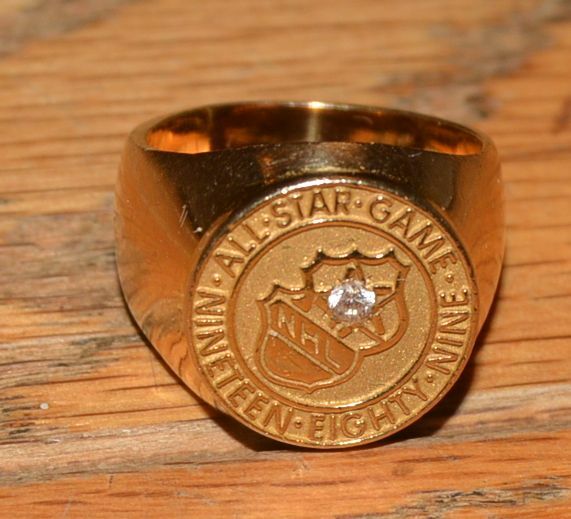
1989 NHL ALL STAR GAME BELONGED TO HALL OF FAMER 14K TIFFANY RING PLAYER ISSUED

When you click on links to various merchants on this site and make a purchase, this can result in this site earning a commission. Affiliate programs and affiliations include, but are not limited to, the eBay Partner Network.

1989 NHL ALL STAR GAME BELONGED TO HALL OF FAMER 14K TIFFANY RING PLAYER ISSUED:
$17593.54
A 1989 TIFFANY & CO 14K SOLID GOLD NHL ALL-STAR GAME RING THAT BELONGED TO HALL OF FAMER
JOSEPH PATRICK MULLEN
HAS HIS INITIALS INSIDE RING AND DATE OF THE 40TH NATIONAL HOCKEY LEAGUE ALL-STAR GAME
WITH A .06ct DIAMOND AND WEIGHS 17.7 GRAMS. THE RING IS APPROXIMATELY A SIZE 8 (SEE PIC)
Joseph Patrick Mullen is an American former professional ice hockey player. He played 16 seasons in the National Hockey League with the St. Louis Blues, Calgary Flames, Pittsburgh Penguins and Boston Bruins between 1980 and 1997. Mullen was named to the First All-Star Team in 1988–89 and played in three NHL All-Star Games.Mullen played with the United States National Team on several occasions, including three Canada Cup tournaments. He was the first American player to score 500 goals and to reach 1,000 points in his career. Mullen received the Lester Patrick Trophy in 1995 in recognition of his contributions to the sport in the United States. He was inducted into the United States Hockey Hall of Fame in 1998 and the Hockey Hall of Fame in 2000.JOE MULLENBIRTHPLACE: New York, NY
BORN: February 26, 1957
TEAMS/ASSOCIATIONS: St. Louis Blues, Calgary Flames, Pittsburgh Penguins, Boston BruinsBioAt the time of his retirement in 1997, Joe Mullen had scored more goals (502) and points (1,063) than any American-born player in NHL history. He earned three Stanley Cups, two Lady Byng Trophies, a Lester Patrick Award and a First Team All-Star berth in his career. he was also inducted into the Hockey Hall of Fame in 2000.
Mullen is a native of New York City and grew up playing roller hockey in the "Hell's Kitchen" section of Manhattan. After playing four years of junior hockey, he went on to play collegiately at Boston College, where he became an All-American in both 1978 and 1979. As a junior in 1978, he even led the Eagles to the NCAA championship game against rival Boston University.
Following college, Mullen was recruited to be a member of the fabled 1980 U.S. Olympic "Miracle on Ice" team. However, because his father was ill at the time, he opted to instead turn pro and use the new income to help out his family. In August of 1979 he signed with the Blues. He was sent down to the CHL for two seasons though, where he proceeded to win both the Rookie of the Year and league MVP awards.
From there he made the jump to the NHL, where, over the next 15 years, he would play with the Blues, Flames, Penguins and Bruins. The speedy and tough goal scorer was a big fan-favorite wherever he played, and his never-say-die attitude made him a winner both on and off the ice.
Perhaps his most memorable season came in 1989, when he led the Calgary Flames to their first-ever Stanley Cup, and in the process, he was named as a first team All-Star, received the Lady Byng Trophy (For sportsmanship) and led the league in plus-minus. Then, in 1995, he became the first American-born player to ever score 1,000 points in an NHL career.
Fellow U.S. Hockey Hall of Fame member, the late Bob Johnson, once said of Mullen, when the Penguins acquired him for a second round pick in 1990, "I'd go to war with Joe Mullen."
Mullen retired from the Penguins in 1997, at the age of 40. In addition, Mullen's brother, Brian, was also in the NHL.
One of the deans of American-born NHL players, Joe Mullen was respected wherever he laced up his skates. Standing 5'9", he wasn't big by league standards, but his will to compete and battle through injuries was formidable. He was a reliable scorer who combined patience, anticipation and a quick release to top the 40-goal mark six times in his career. Mullen earned a permanent place in hockey history by becoming the first American player to score 500 goals and 1,000 points in the NHL.A native of New York City's notorious "Hell's Kitchen," Joe and younger brother Brian learned the game playing on roller skates and using a roll of electrical tape for a puck. He starred in the local amateur league with the 14th precinct and the Westsiders. In 1974-75, he dominated the New York metro junior league with 182 points in a mere 40 games. He was immediately offered a partial scholarship to Boston College, which became a full scholarship in his second year. That first year Mullen had to pay $700 out of his own pocket to attend, but since he was on his way to four outstanding years as an amateur and a stellar pro career, it proved to be a worthwhile investment. During his last two years with the Eagles, Mullen was placed on the Eastern Collegiate Athletic Conference First All-Star Team and the NCAA East First All-American Team.
Following his senior year of college, Mullen represented the United States at the 1979 World Championship, where he averaged a point per game. Just prior to the 1979-80 season, the St. Louis Blues signed him as a free agent. Mullen adjusted to the pro game with ease and was named the Central Hockey League's top rookie in 1979-80 and led the circuit in scoring with 117 points in 1980-81.
Mullen was called up to the Blues in 1981-82 and, with 59 points in only 45 games, quickly became a fan favorite. Blues general manager Emile Francis observed, "Along the boards, he's not the biggest guy in the world, but he's strong and he's got great balance." Mullen was slowed by injuries the next year but still averaged nearly a point per game. In 1983-84, Mullen broke through with 41 goals and started gaining league-wide recognition as a bona fide scorer.
Later that year he registered four points in six games while helping the U.S. reach the 1984 Canada Cup semifinals. He scored a personal high of 92 points in 1984-85, but during this period the Blues failed to make any significant headway in the playoffs.
St. Louis traded Mullen to the Calgary Flames during the 1985-86 season, much to the chagrin of many Blues fans. He adjusted quickly to his new surroundings in Alberta, helping the team reach the Stanley Cup finals for the first time in franchise history, where they lost in five games to the Montreal Canadiens in the spring of 1986.
Following the 1986-87 season, the respected Mullen was presented the Lady Byng Trophy. The popular forward helped the Flames finish with the most points in the NHL in 1987-88, and the following season he registered his first 50-goal year. Mullen led all NHLers in the 1989 playoffs with 16 goals and helped Calgary to its first Stanley Cup victory at the expense of the Canadiens.
He spent one more year in Alberta before he was traded to the Pittsburgh Penguins to contribute experience to a young and improving squad led by Mario Lemieux.
During Mullen's first year with the Penguins, he helped the team win the Stanley Cup for the first time in its history. He contributed 17 post-season points and his veteran savvy as the Pens outlasted the 1967 expansion Minnesota team in a six-game final series.
Mullen started the next year by helping the United States reach the 1991 Canada Cup final. He then scored 42 goals and helped Pittsburgh repeat as Stanley Cup winners. Mullen remained a reliable scorer with 33- and 38-goal totals in 1992-93 and 1993-94. On February 7, 1995, he delighted the home crowd at the Civic Arena by becoming the first American to register 1,000 NHL points.
The popular veteran spent the 1995-96 season with the Boston Bruins before returning to play his final NHL season in Pittsburgh. Just a few weeks before retiring, Mullen scored on Patrick Roy of the Colorado Avalanche to become the first American to score 500 goals. When he stepped away from the game after the 1996-97 season, Mullen stood as the top scoring American of all time. But he still had one more hockey challenge left. After a disastrous showing at the 1998 World Championship, the U.S. had to qualify for the 1999 Worlds during a tournament held in the middle of the NHL season. At 42, Mullen came out of retirement to help his country regain admittance to the most important annual international hockey tournament. With more than 500 career goals and 1,000 career points, Mullen was inducted into the Hockey Hall of Fame in 2000.
In 2000, Joe joined the Pittsburgh Penguins in an assistant coaching capacity, and remained until partway through the 2005-06 season when he was re-assigned as interim coach of the AHL Wilkes-Barre Penguins. He left for a position as assistant coach with the Philadelphia Phantoms of the AHL in 2006-07. The following season, he was hired by the Philadelphia Flyers.
Joey Mullen quietly spent his career as one of the most complete players in the National Hockey League. He excelled at the finesse game as he was an outstanding skater and super sniper. He was dangerous with the puck, and consistent. He was a 35-45 goal threat almost every year in his prime. But he was very conscious of his defensive responsibilities and played a tough game despite his small size.
Yet Mullen was overshadowed by some of his peers. Despite having 6 consecutive 40-plus goal seasons he was only once selected for post season All Star status at right wing. Even in what everyone knew would be his final game he received next to no fanfare. That might be expected though when you retire on the same night as your teammate - Mario Lemieux!
That type of exit seemed to symbolize the career of Joe Mullen. Despite all the great contributions Joey made to his team and to hockey, he rarely got the credit he should have. The ultimate team player who never sought the individual spotlight, is now getting that recognition though. He has been elected to both the Hockey Hall of Fame and the United States Hockey Hall of Fame.
Not bad for a kid from New York’s tough Hell’s Kitchen. Who would ever guess anyone from that neighborhood would ever make the National Hockey League! He and his brother Brian (who also enjoyed a lengthy NHL career) used to have to carry axes in their equipment bags as a form of self protection.
Joe, who perfected his game on rollerblades as a kid, began at Boston College where he recorded 212 points in 111 games for the Eagles and led the team to a league title.
Mullen was never drafted by the NHL, but the St. Louis Blues were bright enough to sign the little forward to a free agent contract in 1979. He then played three years with Salt Lake of the CHL where he was named the league’s top rookie during the 1979-80 season. The following year, he led the CHL in scoring with 117 points and was named the league MVP.
Mullen made it to the "bigs" by 1981-82 and in total played parts of five seasons with St. Louis. In that time he scored 151 goals over five seasons, including back-to-back 40-goal seasons in 1984 and 1985.
Somewhat surprisingly Mullen was part of a 6 player trade that landed him in Calgary during the 1985-86 campaign. It is with Calgary that Mullen enjoyed his best years. In 1986-87, Mullen scored 47 goals and he won the Lady Byng Trophy, becoming the first American-born player to win the Trophy since 1936. He went on to post 5 consecutive season reaching the 40-goal plateau. His best year was 1988-89 when he scored 51 goals and 110 points en route to leading the Calgary Flames to their first Stanley Cup. Mullen led all post season sharpshooters that year in goals with 16. He was selected to the NHL First All-Star team and won his second Lady Byng Trophy. That year, he also became the all-time leading American-born scorer.
Mullen was traded to Pittsburgh prior to the 1990-91 season and his experience and timely offense helped lead the Penguins to back-to-back Stanley Cup championships. In 1991-92, he recorded his seventh season with 40-or-more goals and in 1993-94 he notched his tenth season with 30-or-more goals.
Mullen spent a couple of seasons late in his career bouncing around between Boston and Pittsburgh. He wasn't much of a scorer at that point, but he remained a leader and defensive forward.
Mullen's 16-year NHL career was spent with the St. Louis Blues, Calgary Flames, Boston Bruins and Pittsburgh Penguins. Although never flashy, he was a consistent goal scoring threat and a great team player. A gentleman on the ice, he was awarded the Lady Byng Trophy on two occasions. But he will always be remembered as the first U.S.-born player to score 500 career goals and the first American to record 1,000 career points.
Joe Mullen is the arguably the greatest American born player to date. He helped generate hockey interest in the US and paved the road to success for many of today's American superstars. For his efforts Joe Mullen was named to the United States Hockey Hall of Fame in September of 1998 and Hockey's Hall of Fame came calling 1999.
Today, a look at the Calgary Flames, who were sparked in 1972 as the Atlanta Flames. Named after Union General William Tecumseh Sherman’s March to the Sea which torched Atlanta, the Flames were burnt out of Georgia and moved to Alberta by 1980. In 110 all-time games against the Flames, the Penguins own a 48-41-21 record.
1. Joe Mullen, right winger
One of the greatest United States-born players in NHL history, Mullen’s best years came in Canada with the Flames. Arriving in Calgary via a trade with the St. Louis Blues midway through the 1986-87 season, Mullen reached the 40-goal mark twice before reaching career-highs of 51 goals and 110 points in 1988-89.
In Calgary, Mullen won the Lady Byng Memorial Trophy twice, which recognizes a combination of gentlemanly play as well as high skill, but more importantly, he was a crucial component in helping the Flames win their only Stanley Cup title in 1989. His 16 goals led the NHL that postseason.Little more than a year after that triumph, Mullen, then 33, was traded to the Penguins during the 1990 offseason. Joining fellow veteran newcomer Bryan Trottier, Mullen provided veteran leadership for a younger roster.
Injuries limited Mullen to 47 games and 36 points in 1990-91, but by the postseason, he was healthy enough to contribute eight goals and 17 points in 22 games as the Penguins claimed their first Stanley Cup championship.Mullen reached the 42-goal mark in 77 games during the 1991-92 campaign, but a knee injury sidelined him for most of the postseason. Regardless, he got his name on the Stanley Cup for the third time.
After reaching the 30-goal mark twice in the next three seasons, Mullen joined the Boston Bruins as a free agent in the 1995 offseason before returning to Pittsburgh as a free agent less than a year later.
By the time he retired in 1997, the future Hockey Hall of Famer was the NHL’s career leader among American players in goals (502) and points (1,063).
2. Jean Pronovost, right winger
Acquired in a trade with the Bruins during the 1968 offseason, Pronovost was one of the Penguins’ first stars who achieved that fame by his accomplishments with the franchise rather than previous success elsewhere in the NHL.
A consistent 20- or 30-goal threat in his first four seasons with the Penguins, Pronovost, who scored the first postseason goal in the franchise’s history, erupted for 40 goals in 1973-74 and 1974-75. His greatest success came in 1975-76 when he became the Penguins’ first 50-goal scorer while playing on the famed Century Line along with Syl Apps, Jr. and Lowell MacDonald.
A four-time All-Star, Pronovost, the team’s captain in 1977-78, still holds a prominent place in the Penguins’ record book when it comes to goal-scoring marks. Only Mario Lemieux (690), Sidney Crosby (462), Jaromir Jagr (439) and Evgeni Malkin (416) have scored more goals for the franchise than Pronovost (316).During the 1978 offseason, Pronovost was dealt to Atlanta. With the Flames, he enjoyed two steady 20-goal campaigns, including as captain in 1979-80, before moving on to the Washington Capitals by July of 1980.3. Dan Quinn, center
Quinn was very much a product of his time. That’s to say he was a dynamic offensive center who didn’t play much defense during the free-wheeling NHL of the 1980s.
A first-round pick of the Flames in 1983, Quinn debuted in the NHL as an 18-year-old in 1983-84 and showed gradual improvement until he reached the 30-goal mark during a 1985-86 campaign which ended with a loss to the Montreal Canadiens in the Stanley Cup Final.In November of 1986, the veteran Flames dealt the young Quinn to the Penguins for another entrant on this list, veteran forward Mike Bullard. With the Penguins, Quinn thrived as a No. 2 center behind Lemieux. While opposing defenses focused on Lemieux, Quinn took advantage of lesser defensive matchups and reached the 40-goal mark in 1987-88. His signature season of 1988-89 saw him establish a career best with 94 points in 79 games.After the team had a poor start to the 1989-90 campaign, Quinn was shipped to the Vancouver Canucks as part of a six-player trade in January of 1990. His NHL career came to an end in 1996-97 when he signed with the Penguins and appeared in 16 games.
4. Mike Bullard, center
A first-round pick in 1980, Bullard was the Penguins’ future at the start of the decade. By 1984, he was an afterthought thanks to the arrival of Lemieux.
As a rookie in 1981-82, Bullard showed he was capable of handling the rigors of the NHL by putting up 36 goals in 75 games as a 20-year old. That postseason, he helped the Penguins nearly upset the New York Islanders in a preliminary round series.After regressing a bit with a 22-goal campaign in 1982-83, Bullard claimed a bit of an infamous designation by being the best player on one of the worst teams in NHL history as he paced the 1983-84 Penguins, who essentially tanked to draft Lemieux, with 51 goals and 92 points in 76 games. An All-Star selection that season, not one of his goals was a game-winning score for a squad capable of only 16 victories.
Bullard was one of the few people in Pittsburgh who wasn’t thrilled with Lemieux’s arrival as it pushed him down the depth chart. Not shy to share that sentiment, Bullard was moved to the Flames for Quinn.
Spending parts of two seasons with some strong Flames teams, Bullard’s career season came in 1987-88 when he put up 103 points in 79 games.By September of 1988, Bullard was on the move again, getting traded to the Blues.
5. Jiri Hrdina, center
Entering the NHL at age 30, the Czechoslovakian-born Hrdina only played five seasons in the NHL. But three of those seasons finished with him holding the Stanley Cup.
As geopolitical restrictions were eased in the 1980s, players behind the Iron Curtain were allowed to pursue the sport in North America. Hrdina was an established veteran for his country on the national stage. An eighth-round pick by the Flames in 1984, he made his NHL debut in 1987-88, playing in just nine games.
The next season, he showed he could handle the sport on this continent by producing 22 goals and 54 points in 70 games as a 31-year-old rookie who was mostly used in defensive situations. That spring, he helped Flames win the Stanley Cup.
By December of 1990, the Penguins wanted to aid Jagr, then an 18-year-old who spoke little English, adjust to North America and acquired Hrdina in a trade. Used primarily on the ice in bottom-six and penalty-killing roles, Hrdina’s tutelage steered Jagr into becoming one of the NHL’s greatest players.
In two seasons, Hrdina appeared in 93 games for the Penguins and only produced 36 points. But each of those seasons ended with a Stanley Cup celebration.Following the 1992 title, he returned the newly reformed Czech Republic.
Honorable mentions: Paul Baxter, defenseman; Deryk Engelland, defenseman; Bobby Leiter, center; Noel Price, defenseman; German Titov, left winger.Joseph Patrick Mullen (born February 26, 1957) is an American former professional ice hockey player. He played 16 seasons in the National Hockey League (NHL) with the St. Louis Blues, Calgary Flames, Pittsburgh Penguins and Boston Bruins between 1980 and 1997. He was a member of three Stanley Cup championship teams, winning with the Flames in 1989 and the Penguins in 1991 and 1992. Mullen turned to coaching in 2000, serving as an assistant in Pittsburgh and briefly as head coach of the Wilkes-Barre/Scranton Penguins. He was an assistant with the Philadelphia Flyers from 2007 to 2017.
An undrafted player, Mullen was an all-star for the Boston College Eagles before turning professional in the Blues' organization. He was named the Central Hockey League (CHL) rookie of the year in 1980 and most valuable player in 1981 as a member of the Salt Lake Golden Eagles. He won the Lady Byng Memorial Trophy as the NHL's most gentlemanly player on two occasions as a member of the Flames, as well as the NHL Plus-Minus Award. Mullen was named to the First All-Star Team in 1988–89 and played in three NHL All-Star Games.
Mullen played with the United States National Team on several occasions, including three Canada Cup tournaments. He was the first American player to score 500 goals and to reach 1,000 points in his career. Mullen received the Lester Patrick Trophy in 1995 in recognition of his contributions to the sport in the United States. He was inducted into the United States Hockey Hall of Fame in 1998 and the Hockey Hall of Fame in 2000.Contents1 Early life2 Playing career2.1 College2.2 St. Louis Blues2.3 Calgary Flames2.4 Pittsburgh and Boston2.5 International3 Playing style4 Coaching career5 Personal life6 Career statistics6.1 Regular season and playoffs6.2 International6.3 Coaching7 Awards and honors8 See also9 References10 External linksEarly lifeBorn February 26, 1957, in New York, New York, Mullen grew up in the Hell's Kitchen neighborhood of Manhattan when it was controlled by the Gambino crime family.[1] It was a rough neighborhood; Mullen later said that many of the people he grew up with fell into gangs and drug use, and several died before turning 21.[2] He has three brothers, Ken, Tom Jr. and Brian, and a sister, Debbie.[3]
The Mullen family lived less than a block from Madison Square Garden, where Joe's father Tom was a longtime employee on the ice and maintenance staffs. Joe and his brothers often hung around the arena with their father, taking old sticks to play with.[3] He began playing roller hockey at the age of five, playing in a concrete schoolyard and using a sanded down roll of electrical tape as a puck.[2] The boys' schoolyard games served as a partial inspiration for New York Rangers' general manager, Emile Francis, to create the Metropolitan Junior Hockey Association in 1966.[1] Mullen did not learn to ice skate until he was ten years old, but at the age of 14 joined the Metropolitan association as one of the league's youngest players.[3] Mullen played four seasons in the league between 1971 and 1975.[4] He scored 71 goals in 1973–74, then 182 points in 40 games the following season. Mullen's 110 goals in 1974–75 was 52 more than his nearest competitor.[3]
Playing careerCollegeBoston College offered Mullen a partial scholarship for the 1975–76 season to attend and play for the Eagles hockey program. He paid $700 out of his own pocket in the first year, but after scoring 34 points in 24 games as a freshman, the school gave him a full scholarship.[5] Including tournament games, he led the Eagles in goals the following three seasons with 39, 38 and 30 respectively, and points in 1977–78 with 68 and in 1978–79 with 56.[6] Mullen led the Eagles to the Eastern College Athletic Conference (ECAC) championship in 1977–78, and was named an all-star of the 1978 National Collegiate Athletic Association (NCAA) tournament.[7] He scored a goal in the championship game, but the Eagles lost to cross-town rival Boston University, 5–3.[8]
In four seasons with Boston College, Mullen set school records of 110 goals and 212 points (both subsequently broken).[9] He was named to the All-ECAC, All-New England and NCAA All-American teams in 1978 and 1979.[5][10] He won the Walter Brown Award in 1978 as the top American-born player in New England,[8] and was the team captain in 1978–79.[11] Boston College has twice honored Mullen; He was inducted into the school's Varsity Club Hall of Fame in 1998, while the hockey program retired his jersey number 21 the following year.[12]
St. Louis BluesWhile Mullen had a successful college career, he went undrafted by any National Hockey League (NHL) team.[1] His small stature, coupled with a general bias against American players at the time, especially from non-traditional development areas, contributed to his failure to be selected.[13] However, he received interest as a free agent from several teams following graduation as well as the United States Olympic Team.[3] He passed up the opportunity to play in the 1980 Winter Olympics and signed with the St. Louis Blues on August 16, 1979.[14] The Blues assigned Mullen to their Central Hockey League (CHL) affiliate, the Salt Lake Golden Eagles for the 1979–80 season. In 75 games with the Golden Eagles, Mullen scored 40 goals and 72 points.[4] He was named to the CHL's second all-star team and was voted rookie of the year.[5] He made his NHL debut in the 1980 Stanley Cup Playoffs, appearing in one game for the Blues.[5]
Mullen returned to Salt Lake for the 1980–81 season where he scored 59 goals and led the league with 117 points.[15] He was named to the first all-star team and won the CHL's Most Valuable Player Award.[14] Opening the 1981–82 season with Salt Lake, Mullen had 21 goals in 27 games before he was recalled to St. Louis.[4] He scored his first two NHL goals on January 5, 1981, against the Minnesota North Stars. They came eight seconds apart and set a Blues' franchise record for fastest two goals by one player.[3] Mullen scored 25 goals for the Blues that season and became the first player in history to score at least 20 goals in both the minor leagues and the NHL in the same season.[1]
Injuries reduced Mullen to 49 games with the Blues in 1982–83,[16] but he still scored 47 points.[4] His 41 goals in 1983–84 set a record as the most scored by an American-born player in NHL history (broken by Bobby Carpenter the following season).[17] He again reached the 40-goal plateau in 1984–85, and had 92 points total.[16] He missed the first three days of the Blues' training camp prior to the 1985–86 season in a contract dispute before agreeing to a one-year deal.[18] On February 1, 1986, the Blues dealt him to the Calgary Flames as part of a six player trade. Mullen went to Calgary, along with Terry Johnson and Rik Wilson, for Eddy Beers, Charlie Bourgeois and Gino Cavallini.[19]
Calgary FlamesThe Flames felt they needed a quality offensive player and expected Mullen to fulfill that role.[19] As it was the first time in his career he had been traded, Mullen was initially upset at the move. He was awed by the reaction he received from fans in Calgary however; fans greeted him warmly even as his flight landed to arrive in the city. Mullen described the experience as being "almost like ... an instant celebrity".[5] He quickly established himself as a fan favorite, scoring 38 points in 29 games to end the regular season.[20] He then led the league with 12 goals in the 1986 Stanley Cup Playoffs.[14] The Flames reached the final for the first time in franchise history, but lost to the Montreal Canadiens in five games.[16] Mullen set a personal best of 47 goals in his first full year in Calgary, 1986–87, and with only 14 penalty minutes on the season, was voted the winner of the Lady Byng Memorial Trophy as the NHL's most gentlemanly player.[15]
Mullen's 40 goals in 1987–88 was the fifth consecutive season he reached that total.[4] He won his first of three consecutive Molson Cups as the Flames player with the most three star selections during the season.[21] 1988–89 was Mullen's best season in the NHL.[1] He reached the 50 goal and 100 point milestones, leading the Flames with 51 and 110 respectively, and won his second Lady Byng Memorial Trophy.[20] He was named a First-Team All-Star at right wing and won the Plus-Minus Award at +51.[22] Additionally, he played in his first NHL All-Star Game, appearing opposite his brother Brian.[23] He led the 1989 Stanley Cup Playoffs with 16 goals as the Flames defeated the Canadiens to win their first Stanley Cup championship.[20]
Though he played in his second All-Star Game in 1990,[22] Mullen's production fell by 41 points, to 69, and he failed to score at least 40 goals for the first time in six seasons.[4] Concerned about his age, the Flames chose to trade the 33-year-old Mullen following the season.[24] He was sent to the Pittsburgh Penguins in a draft day trade on June 16, 1990, in exchange for Pittsburgh's second round selection.[25]
Pittsburgh and BostonThe move to Pittsburgh brought Mullen closer to his New York home and fulfilled his desire to raise his family in his native United States. He also appreciated that the Penguins felt he could aid their team. Penguins' coach Bob Johnson, who had previously coached him in Calgary, influenced the team's decision to acquire him.[5] Mullen played only 47 games in 1990–91, scoring 17 goals and 39 points. He missed the last two months of the regular season after having surgery to remove a herniated disc in his back,[26] an injury for which he could not identify a specific check or incident as the cause.[27] He returned for the third game of the Penguins' first-round playoff series against the New Jersey Devils, scoring a goal. Mullen finished the 1991 Stanley Cup Playoffs with eight goals, including two in game six of the final, an 8–0 victory over the Minnesota North Stars that clinched Pittsburgh's first Stanley Cup.[26]
Healthy throughout the 1991–92 season, Mullen rebounded offensively to score 42 goals and 87 points in 77 games.[4] Midway through the season, he became the first player in Penguins' history to have consecutive four-goal games, doing so against the New York Islanders on December 23, 1991, and the Toronto Maple Leafs three days later.[28] He appeared in only nine playoff games, however, as he suffered a knee injury that required surgery to repair in the second game of Pittsburgh's second-round series against the New York Rangers.[29] Mullen watched from the sidelines as the Penguins repeated as Stanley Cup champions.[5]
Mullen tested free agency prior to the 1992–93 season, but ultimately chose to remain with the Penguins.[29] He missed the first month of the season while recovering from his knee surgery,[29] but finished the season with 33 goals and 70 points in 72 games. He added 6 points in 12 playoff games,[4] but the Penguins' attempt at a third consecutive championship ended with a second-round loss to the New York Islanders.[30] A 38-goal season in 1993–94 led to Mullen's third All-Star Game appearance. The game was a homecoming of sorts for Mullen, as it was played in Madison Square Garden.[31]
In the lockout-shortened 1994–95 season, Mullen scored 37 points in 45 games.[4] He scored the 1,000th point of his career with a pair of assists on February 7, 1995, in a 7–3 victory over the Florida Panthers.[32] He left the Penguins following the season, signing a one-year contract as a free agent with the Boston Bruins. Mulen chose to wear number 11 with the Bruins as his usual number 7 had been retired by the Bruins in honor of Phil Esposito.[33] He missed the majority of the season after requiring surgery for another herniated disc,[34] then suffering a sprained medial collateral ligament.[35] He appeared in only 37 games, scoring 15 points.[4]
Mullen rejoined the Penguins for the 1996–97 season, signing a one-year contract.[36] He appeared in 54 games and scored 22 points.[4] He scored his 500th career goal on March 14, 1997, in a 6–3 loss to the Colorado Avalanche.[37] He retired as a player following the season.[38]
InternationalMullen made his first appearance with the United States National Team following his graduation from Boston College.[16] He appeared in eight games at the 1979 World Ice Hockey Championships, scoring seven goals and adding an assist for the seventh place Americans.[39] He was a member of three Canada Cup teams, appearing at the 1984, 1987 and 1991 tournaments.[4] He scored two goals in the 1991 tournament, both of which came in a 7–3 semi-final victory over Finland that led the United States into their first tournament final.[40] The Americans settled for second place, however, after losing to Canada in the championship series.[39]
At the age of 41, Mullen emerged from retirement to join the Americans for a qualifying tournament leading into the 1999 Men's World Ice Hockey Championships.[41] The United States had a disastrous 12th-place finish in the 1998 tournament, requiring them to go into a qualifying round to avoid relegation to the B division for 1999.[42] As the qualifying tournament was played in November, American NHL players were not available.[41] Mullen recorded three assists in three games,[4] and helped the Americans stay in the top division for the 1999 tournament.[43]
Playing style"Mully spent a career excelling in areas of the ice a lot of guys wouldn't visit on a threat of death. Great balance on his skates. Great desire. Great teammate. A little guy with big talent and a huge heart."—Former teammate Brad McCrimmon[20]Mullen arrived in the NHL possessing great balance on his skates, an ability his teammates and coaches believed he gained from playing roller hockey.[3] His coaches praised his willingness to play in the difficult areas of the ice, even though he stood only five foot nine inches tall and knew he would have to take a hit to make a play.[20] Penguins' play-by-play announcer Mike Lange nicknamed Mullen "Slippery Rock Joe" for his ability to evade opposing players.[44]
The first American player in NHL history to score 500 goals and 1,000 points,[14] Mullen's career totals of 502 goals and 1,063 points stood as American records until surpassed by Mike Modano[45] and Phil Housley,[46] respectively. Along with his brother Brian, Mullen was named a recipient of the Lester Patrick Award in 1995 in recognition of his contributions to hockey in the United States.[47] He was inducted into the United States Hockey Hall of Fame in 1998,[48] and two years later, to the Hockey Hall of Fame.[49] In 2011, the St. Louis Blues honored four players who wore uniform number 7 for their team. Mullen, Red Berenson, Garry Unger and Keith Tkachuk were each celebrated as part of the ceremony.[50]
Coaching careerMullen turned to coaching in 2000, joining the Penguins' staff as an assistant under Ivan Hlinka.[51] He remained on the staff when Hlinka was fired one year later, under replacement Rick Kehoe,[52] then Ed Olczyk. Mullen was removed from his role midway through the 2005–06 NHL season when the Penguins fired Olczyk and his entire staff. He was retained by the organization, however, and named interim head coach of the Wilkes-Barre/Scranton Penguins for the remainder of the American Hockey League (AHL) season.[53] In 52 games, Mullen achieved a record of 28 wins, 16 losses, 3 ties and 5 overtime losses.[54] The Penguins chose not to retain Mullen following the season.[55] He moved to Pittsburgh's cross-state rival, the Philadelphia Flyers, first as an assistant with the AHL's Philadelphia Phantoms in 2006–07,[54] then joining the NHL team in 2007.[56] Mullen coached the team's power play, and was a member of the staff when the team reached the 2010 Stanley Cup Final.[57] He remained on the Flyers' staff through the end of 2016–17 season.[58]
Personal lifeMullen and his wife, Linda, have four children: sons Ryan, Michael and Patrick, and a daughter: Erin.[59] Patrick is also a professional hockey player. He signed a contract with the Ottawa Senators organization for the 2013–14 season.
Career statisticsRegular season and playoffs Regular season PlayoffsSeason Team League GP G A Pts PIM GP G A Pts PIM1971–72 New York 14th Precinct NYJHL 30 13 11 24 2 — — — — —1972–73 New York Westsiders NYJHL 40 14 28 42 8 — — — — —1973–74 New York Westsiders NYJHL 42 71 49 120 41 7 9 9 18 01974–75 New York Westsiders NYJHL 40 110 72 182 20 13 24 13 37 21975–76 Boston College Eagles ECAC 24 16 18 34 4 — — — — —1976–77 Boston College Eagles ECAC 28 28 26 54 8 — — — — —1977–78 Boston College Eagles ECAC 34 34 34 68 12 — — — — —1978–79 Boston College Eagles ECAC 25 32 24 56 8 — — — — —1979–80 Salt Lake Golden Eagles CHL 75 40 32 72 21 13 9 11 20 01979–80 St. Louis Blues NHL — — — — — 1 0 0 0 01980–81 Salt Lake Golden Eagles CHL 80 59 58 117 8 17 11 9 20 01981–82 Salt Lake Golden Eagles CHL 27 21 27 48 12 — — — — —1981–82 St. Louis Blues NHL 45 25 34 59 4 10 7 11 18 41982–83 St. Louis Blues NHL 49 17 30 47 6 — — — — —1983–84 St. Louis Blues NHL 80 41 44 85 19 6 2 0 2 01984–85 St. Louis Blues NHL 79 40 52 92 6 3 0 0 0 01985–86 St. Louis Blues NHL 48 28 24 52 10 — — — — —1985–86 Calgary Flames NHL 29 16 22 38 11 21 12 7 19 41986–87 Calgary Flames NHL 79 47 40 87 14 6 2 1 3 01987–88 Calgary Flames NHL 80 40 44 84 30 7 2 4 6 101988–89 Calgary Flames NHL 79 51 59 110 16 21 16 8 24 41989–90 Calgary Flames NHL 78 36 33 69 24 6 3 0 3 01990–91 Pittsburgh Penguins NHL 47 17 22 39 6 22 8 9 17 41991–92 Pittsburgh Penguins NHL 77 42 45 87 30 9 3 1 4 41992–93 Pittsburgh Penguins NHL 72 33 37 70 14 12 4 2 6 61993–94 Pittsburgh Penguins NHL 84 38 32 70 41 6 1 0 1 21994–95 Pittsburgh Penguins NHL 45 16 21 37 6 12 0 3 3 41995–96 Boston Bruins NHL 37 8 7 15 0 — — — — —1996–97 Pittsburgh Penguins NHL 54 7 15 22 4 1 0 0 0 0NHL totals 1062 502 561 1063 241 143 60 46 106 42InternationalYear Team Comp GP G A Pts PIM1979 United States WC 8 7 1 8 21984 United States CC 6 1 3 4 21987 United States CC 4 3 0 3 01991 United States CC 8 2 3 5 01999 United States WC 3 0 3 3 0Senior totals 29 13 10 23 4CoachingSeason Team League Regular season Post seasonG W L OTL SOL Pct Division rank Result2005–06 Wilkes-Barre/Scranton Penguins AHL 52 28 16 3 5 .615 1st East Division Lost in second roundAHL totals 52 28 16 3 5 .615 Awards and honorsAward Year UniversityWalter Brown AwardOutstanding American-born player in New England 1978 [8]All-NCAA All-Tournament Team 1978 [60]All-ECAC Hockey First Team 1977–781978–79 [14]All-New England Team 1977–781978–79 [10]AHCA East All-American 1977–781978–79 [14]Central Hockey LeagueRookie of the Year 1979–80 [14]Second All-Star Team 1979–80 [14]Most Valuable Player 1980–81 [14]First All-Star Team 1980–81 [14]Award Year National Hockey LeagueLady Byng Memorial TrophyGentlemanly conduct 1986–871988–89 [22]NHL Plus-Minus Award 1988–89 [22]First All-Star Team 1988–89 [61]Played in NHL All-Star game 1989,1990,1994 [22]Stanley Cup champion 1988–891990–911991–92 [16]Lester Patrick TrophyContribution to hockey in the United States 1995 [4]Team awardsMolson CupMost three-star selections (Calgary)1986–871987–881988–89 [21]See alsoList of members of the Hockey Hall of FameList of members of the United States Hockey Hall of Fame
1989 NHL ALL STAR GAME BELONGED TO HALL OF FAMER 14K TIFFANY RING PLAYER ISSUED:
$17593.54
Related Items:
1989 NHL ALL STAR GAME BELONGED TO HALL OF FAMER 14K TIFFANY RING PLAYER ISSUED
$17593.54
1989 Minnesota North Stars NHL Hockey Team Deck Vintage Playing Cards By Skore
$58.50
Hartford Whalers vs Krylya Sovetov Moscow December 27 1989 NHL Hockey Pin
$30.89