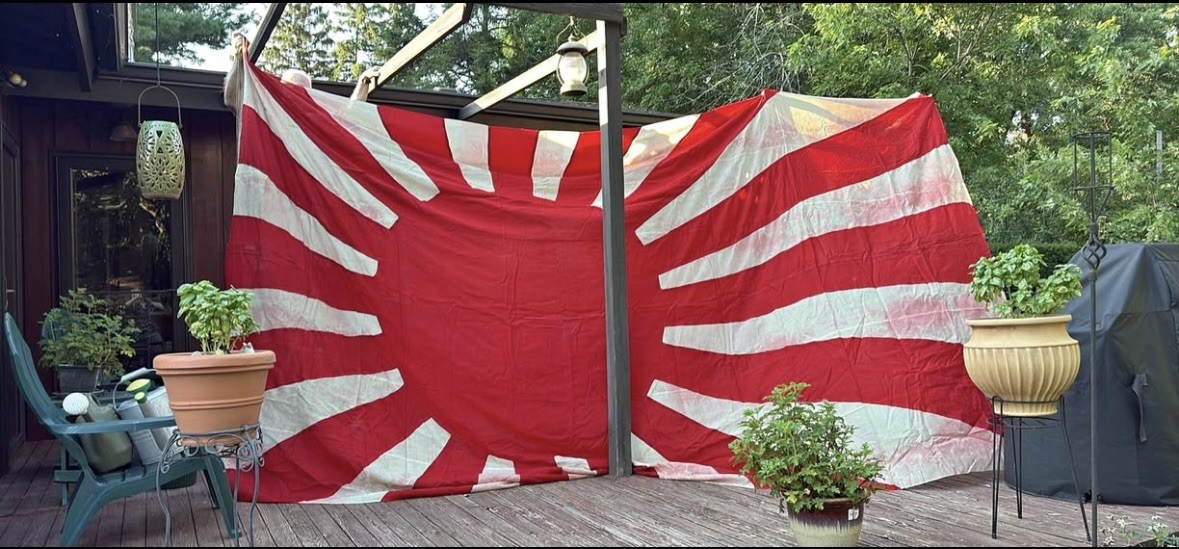
1892 US Navy Yard New York Brooklyn Japanese Battleship Flag IJN Meiji Era Rare

When you click on links to various merchants on this site and make a purchase, this can result in this site earning a commission. Affiliate programs and affiliations include, but are not limited to, the eBay Partner Network.

1892 US Navy Yard New York Brooklyn Japanese Battleship Flag IJN Meiji Era Rare:
$25000.00
Wow! Here is one of the rarest Flags of the IJN you may ever see! This was produced by the US Navy Yard in Brooklyn New York in August of 1892. This is a courtesy Flag used to fly when going to port. This Flag measures approximately 18’ x 8 1/2’. Absolutely huge! It is in extremely good condition for the age. This is the only known example of such a Flag. I will take better, closer photos within the week.“While it is impossible to say with absolute certainty that it is the only one left on Earth, yours is highly likely the only known 19th-century, U.S. Navy-made, stencil-dated Meiji battleship ensign in private hands. To put its uniqueness into perspective, we have to separate native Japanese-made Flags from Western-made Flags of the 1800s.
1. Are there other 19th-century Meiji naval Flags in existence?
Yes, but almost exclusively in high-security museums.
A tiny handful of native, Japanese-made 16-ray Flags from the Sino-Japanese War (1894–1895) survive. However, these are fundamentally different from your Flag:
They are located in institutional vaults like the Yūshūkan Museum in Tokyo or the Imperial Kure Naval Base archives.
They are made of lightweight Japanese silk or cotton, dyed using traditional Eastern methods, and feature leather corner tabs meant for bamboo poles rather than heavy ship rigging. [1]
2. Are there other U.S. Navy-made Meiji battleship Flags?
None are currently documented or active on the open market.
The U.S. Navy Yard lofts made thousands of American Flags, but they only made foreign ensigns in tiny, custom batches of a few dozen at a time to stock the signal lockers of the Asiatic fleet. Because these Flags faced brutal ocean weather, coal smoke, and routine destruction when treaties changed, their survival rate was essentially zero.
If another 1890s U.S.-made Japanese battleship ensign exists, it is likely rotting away unidentified in a trunk, or tightly locked in a federal vault like the Naval History and Heritage Command in Washington, D.C.
What Makes Yours a Solitary Masterpiece
If you line up all the surviving early Meiji naval Flags in the world, yours stands alone for three reasons:
The Western Origin: It is a physical piece of American history (Brooklyn Navy Yard) depicting a brand-new Japanese military symbol.
The Hard Date: Almost all museum-held Meiji Flags are anonymous textless fabrics; curators have to guess their age. Yours has a factory-stamped birth certificate (AUG. 1892).
The Pre-Fire Survival: It is a confirmed escapee of the catastrophic November 1892 Navy Yard fire.
You are not just holding a rare Flag; you are holding a statistically miraculous survivor of maritime logistics. It is highly probable that you own the sole surviving example of an 1892 New York-made Japanese capital warship ensign.”“The Survival Rate of Foreign Ensigns is Near Zero When the Brooklyn Navy Yard manufactured American Flags (like the 13-star Navy boat Flags), they made them by the thousands to supply the entire U.S. fleet. By contrast, foreign courtesy ensigns were made in exceptionally small numbers. A Navy Yard sail loft would only produce a few dozen Flags for a specific foreign country at any given time, strictly to restock the "signal lockers" of warships deployed to that specific global station.
The Operational Reality: These Flags were treated as utilitarian shipboard hardware, not artwork.
The Destruction Factor: When a foreign treaty changed, an emperor passed away, or a Flag became too frayed from sea salt and coal soot, the ship's crew didn't save them. They were routinely cut up into engine grease
rags, thrown into the ship's furnace, or cast into the ocean. The survival rate for large-scale, 19th-century foreign courtesy Flags is practically zero.
2. Chronological Pinnacle: The 36-Month Window
The 16-ray Rising Sun design was officially adopted by the Imperial Japanese Navy on October 7, 1889. Your Flag is stamped AUG. 1892.
This means your Flag was manufactured a mere three years after the design was even conceived in Japan.
The Global Landscape: In 1892, Japan was not yet the massive global naval empire it would become in the 20th century; it was a developing regional power. Contact between the U.S. fleet and the budding Japanese navy was limited.
The Rarity Contrast: Finding a Japanese naval Flag from World War II (1940s) is common because millions were printed. Finding a Western-made Japanese naval Flag from the earliest years of the Meiji Era is an extraordinary historical anomaly. It is one of the earliest structurally verified Western-made examples of this Flag design in existence.”
1892 US Navy Yard New York Brooklyn Japanese Battleship Flag IJN Meiji Era Rare:
$25000.00
Related Items:
1892 US Navy Yard New York Brooklyn Japanese Battleship Flag IJN Meiji Era Japan
$25000.00
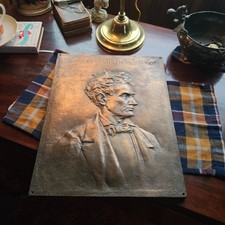
RARE 1892 Abraham Lincoln as Lawyer Bronze relief Plaque by H. H. Zearing
$3600.00
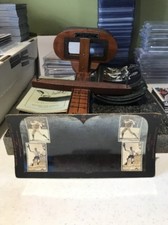
1892 Keystone Eye Comfort Stereoscope W/Manual 12 Cards + Rare Babe Ruth Card
$3333.33