George III Royal Sign Manual Military Establishment American Revolutionary War

When you click on links to various merchants on this site and make a purchase, this can result in this site earning a commission. Affiliate programs and affiliations include, but are not limited to, the eBay Partner Network.

George III Royal Sign Manual Military Establishment American Revolutionary War:
$50000.00
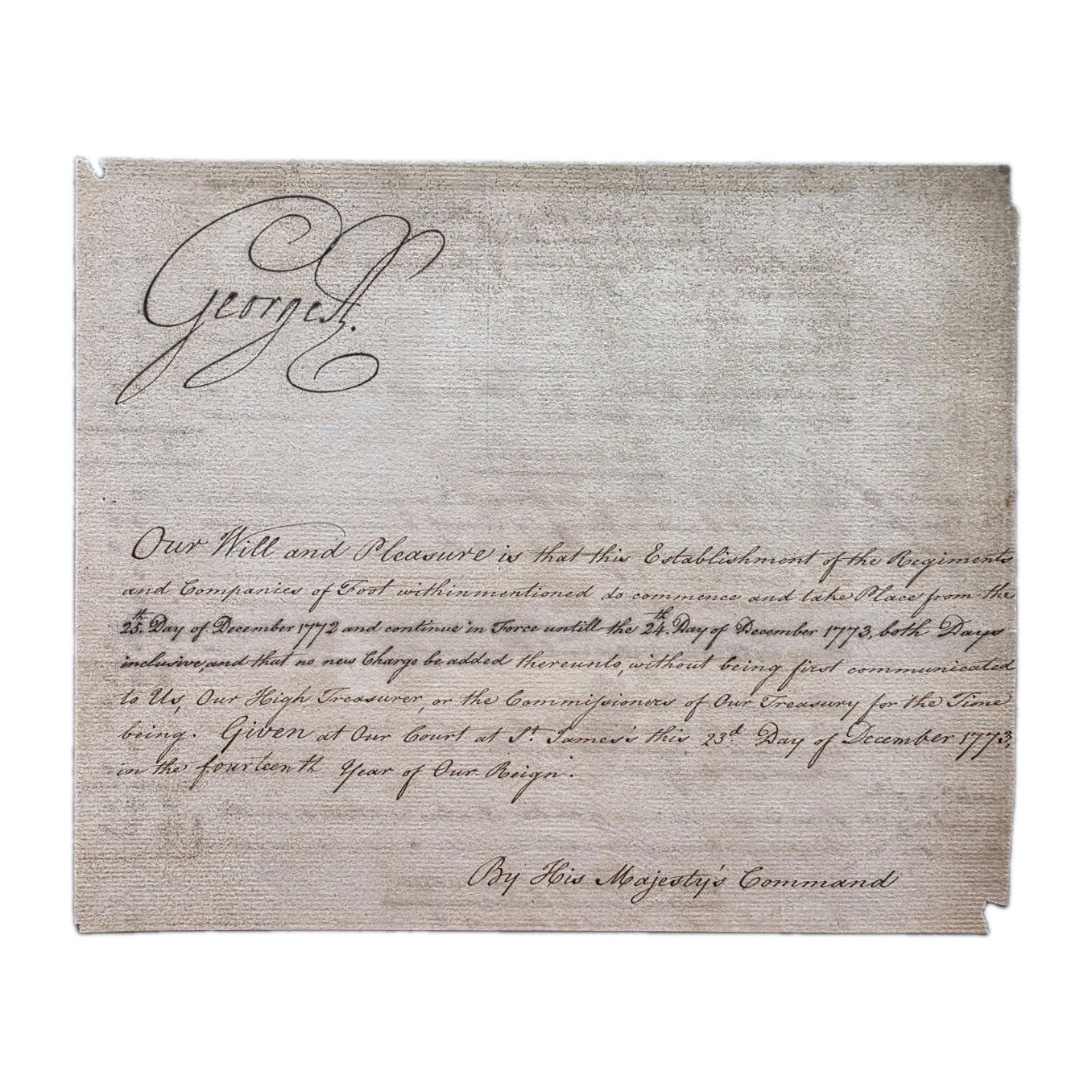
For your consideration is an exceptionally rare and historically important Royal Sign Manual military establishment warrant signed by King George III (1738–1820), issued at the Court of St. James's on 23 December 1773, formally approving the general annual Establishment of the Regiments and Companies of Foot for the military service year extending from 25 December 1772 through 24 December 1773. This was not a commission, promotion, recruiting warrant, or routine military order, but one of the principal constitutional instruments by which the British Crown annually organized, regulated, and financed the regular infantry of the British Army. The regiments established and maintained under this warrant, together with their command structures and many of their officers, non-commissioned officers, and enlisted men, formed the institutional core of the professional army that, scarcely sixteen months later, marched against the American colonies under King George III and ultimately fought General George Washington throughout the American Revolutionary War. Entirely manuscript in an elegant contemporary governmental secretarial hand and boldly subscribed "George R." by the King, the surviving document is executed on both sides of a single leaf of original laid paper measuring approximately 9¾ × 8 inches, bearing a prominent royal crown watermark identifying it as official Crown stationery. The recto preserves the complete royal warrant, while the verso commences the establishment schedules, identifying the manuscript as the surviving opening leaf of a substantially larger official instrument that originally continued through the complete annual establishment of Britain's Regiments and Companies of Foot. As an original surviving portion of the constitutional and administrative machinery by which Britain's standing army was maintained, the manuscript occupies a category of historical importance far exceeding that of the ordinary royal warrant or signed military document.
The operative clause declares: "Our Will and Pleasure is that this Establishment of the Regiments and Companies of Foot withinmentioned do commence and take Place from the 25th Day of December 1772 and continue in Force until the 24th Day of December 1773... and that no new Charge be added thereunto, without being first communicated to Us, Our High Treasurer, or the Commissioners of Our Treasury for the Time being." It concludes: "Given at Our Court at St. James's this Twenty Third Day of December 1773 in the Fourteenth Year of Our Reign. By His Majesty's Command." These words embody the constitutional relationship between the Crown, Parliament, the Treasury, and the standing army following the constitutional settlement of the late seventeenth century. Annual establishments prescribed the authorized organization, command structure, officer complements, company establishments, manpower, pay, allowances, and recurring financial obligations of the regular infantry maintained upon the British Establishment, while simultaneously prohibiting the addition of any new military expense without royal and Treasury approval. The present manuscript therefore survives not merely as an autograph of George III, but as an executive state paper governing the legal, administrative, and financial framework of Britain's regular infantry immediately before the outbreak of the American Revolutionary War.
The verso preserves the commencement of the establishment schedules for the regiment "commanded by Lieut. Genl. John Duke of Argyll," identifying John Campbell, 5th Duke of Argyll, Colonel of the 1st, or Royal, Regiment of Foot, Britain's senior regiment of line infantry, later known as the Royal Scots. Under the heading "Field and Staff Officers," the manuscript records the authorized establishment of the Colonel, Lieutenant-Colonel, Major, Chaplain, Adjutant, Quartermaster, Surgeon, and Surgeon's Mate before proceeding to "One Company," consisting of one Captain, one Lieutenant, one Ensign, two Sergeants, three Corporals, one Drummer, and thirty-eight Private Men, together with allowances for widows, recruiting, clothing lost through desertion, and the regimental agent. It continues with "Seven Companies more of the like Number and Rates," confirms the regiment's ten-company establishment, and begins the separate establishment of the Grenadier Company. The surviving schedule is particularly significant because it reflects the comprehensive infantry reforms introduced by the Crown in 1770–1771, under which every Regiment of Foot maintained upon the annual Establishment included an organic Light Infantry Company as part of its authorized ten-company organization. Although the surviving manuscript breaks off before that schedule appears, the light company formed an integral component of the regiment's establishment by regulation and was therefore necessarily governed by this warrant. Those light companies, together with the grenadier companies of the line regiments, subsequently furnished the elite composite Light Infantry Battalions and Grenadier Battalions that spearheaded British operations throughout the American Revolutionary War. Consequently, the manuscript preserves not merely the administrative establishment of Britain's senior regiment, but the constitutional foundation of one of the most important tactical reforms in eighteenth-century British military history.
The historical timing of the warrant is extraordinary. George III signed the manuscript on 23 December 1773, only seven days after the Boston Tea Party, yet before news of that defining event had crossed the Atlantic and reached London. The document therefore captures a singular constitutional moment in which the British government was completing the routine annual administration of its regular army while remaining entirely unaware that the imperial crisis had entered its decisive phase. Within months Parliament enacted the Coercive Acts, imperial policy shifted from civil administration to military enforcement, and the regiments maintained under this annual Establishment became the institutional army from which Britain's Revolutionary forces were organized, augmented, and deployed against Washington's Continental Army. Washington himself had learned many of the principles of command, discipline, and military administration while serving alongside British regulars during the French and Indian War; the present warrant records the mature professional military establishment that he would later confront, campaign after campaign, as Commander in Chief. The organic light infantry companies governed under this Establishment were detached with the grenadier companies of their respective regiments to form the elite flank battalions repeatedly identified in Washington's own correspondence and intelligence reports and employed against his army in the campaigns of New York, New Jersey, Brandywine, Germantown, Monmouth, and elsewhere. Accordingly, the document preserves the institutional military framework from which the British Army that fought George Washington directly emerged.
From the standpoint of historical importance and rarity, the manuscript occupies an exceptional position among surviving George III military documents. Public sale records commonly include commissions, promotions, recruiting warrants, Treasury orders, clothing warrants, and regional military establishments relating to individual regiments or overseas garrisons. By contrast, the present manuscript represents the general annual Establishment of the Regiments and Companies of Foot itself—the constitutional instrument governing the organization of Britain's regular infantry as a whole. Rather than documenting a single regiment or isolated military transaction, it preserves the opening portion of the annual state paper through which the Crown prescribed the establishment of the British infantry immediately before the American Revolution. The regiments governed under this Establishment—including the 4th (King's Own), 5th, 10th, 15th, 17th, 18th (Royal Irish), 22nd, 23rd Royal Welch Fusiliers, 27th (Inniskilling), 33rd, 35th, 37th, 38th, 40th, 42nd Royal Highland (Black Watch), 43rd, 44th, 45th, 47th, 49th, 52nd, 57th, 60th Royal American, 62nd, 63rd, 64th, 65th, and numerous others—formed the enduring institutional structure of the British Army that campaigned against the United States throughout the War of Independence. Although individual officers and enlisted men naturally changed through promotion, recruitment, casualties, retirement, discharge, and desertion, the regiments, company establishments, officer structures, light infantry companies, grenadier companies, and administrative system established under annual warrants such as the present manuscript continued as the professional military foundation of Britain's Revolutionary Army. In this respect, the manuscript should be understood not merely as a document signed by George III, but as an original constitutional military state paper documenting the legal, financial, and administrative organization of the British Army immediately before its confrontation with George Washington and the birth of the United States.
Condition is entirely consistent with an official eighteenth-century government manuscript surviving as the opening leaf of a once-complete annual Establishment. Executed upon original crown-watermarked laid paper, the document retains George III's exceptionally large and bold autograph signature together with the complete operative warrant and the commencement of the establishment schedules for Britain's senior Regiment of Foot. Original folds, moderate age toning, scattered light soiling, and minor marginal losses from earlier mounting are present, while the remaining establishment schedules have been historically separated. Despite those losses, the manuscript survives with remarkable documentary integrity, preserving both the King's complete constitutional authorization and the opening establishment of the regiment standing first in the British line within the general annual Establishment that governed the British Army at one of the most consequential moments in Anglo-American history. As the surviving opening leaf of the general annual Establishment of the Regiments and Companies of Foot, executed only days after the Boston Tea Party and immediately before Britain's regular army entered the American Revolutionary era, it constitutes an exceptionally rare and important survival of Georgian statecraft and military administration, preserving the constitutional foundation of the professional army that would soon wage war against George Washington and the emerging United States.
George III Royal Sign Manual Military Establishment American Revolutionary War:
$50000.00
Related Items:

English George III Automaton Musical Bell Strike Monk Gilt Bronze Bracket Clock
$55000.00
1773 King George III Signed Royal Warrant to Create Army American Revolution War
$34975.00

Antique George III Regency Style Sterling Silver Samovar
$23620.00