1914-15 Star Trio - Killed in Action 1st July 1916 - Owen Warwickshire Regiment


When you click on links to various merchants on this site and make a purchase, this can result in this site earning a commission. Affiliate programs and affiliations include, but are not limited to, the eBay Partner Network.

1914-15 Star Trio - Killed in Action 1st July 1916 - Owen Warwickshire Regiment:
$1131.78
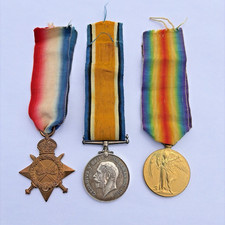
An original World War One 1914-15 Star Medal Trio to a soldier who served with the 8th Battalion Royal Warwickshire Regiment and who was killed in action on the 1st July 1916 - the 1st Day of the Battle of the Somme.
The medals were awarded to 3043 / 305658 Private John Richard Owen who came from Clun in Shropshire
The 1915 Star is named:
3043PTE. J. R. OWEN. R. WAR. R.
The British War and Victory Medals are both named:
305658 PTE. J. R. OWEN. R. WAR. R.
The medals all have their original silk ribbons.
John was born in1894 in Clun, Shropshire and hewas baptised on 1st July 1894.
The 1901 Census shows John living at 81 Newport Street, Clum with his father William, mother Laura and three sisters.
His father William was a groom / gardener.
The 1911 Census shows John aged 16 and working as a groom cowboy and still living in Clun with his father and five siblings - two sisters and three brothers - and his step mother Martha Owen. John's mother Laura having died in the intervening years.
John enlisted into the Royal Warwickshire Regiment in Birmingham in 1914.
He has two medal index cards for his service numbers 3043 and 305658 and he is confirmed as having both service numbers on the Army Register of Soldiers Effects and Soldiers Died.
John landed in France on 25th June 1915 and he was killed in action on 1st July 1916.
Some details of the action on that day from the Great War Forum about the action of the Regiment that day:
The British attack on July 1, 1916, extended from Gommecourt to Maricourt, where the French Sixth Army, which lay astride the Somme, was to take it up. At the north of the British line was the Seventh Corps, and next it on the south was the Eighth Corps, under General Hunter-Weston, which in-cluded the 48th and 4th Divisions, with the four Warwickshire Territorial battalions in the 143rd Brigade, and the 1st Royal Warwickshire in the 10th Brigade. Its line faced Serre and Beaumont Hamel. East from Albert, in the Fifteenth Corps, the 7th Division with the 2nd Royal Warwickshire lay before Mametz. The enterprise in each region had its special char-acter, and in effect there were two independent actions, one in the north, which failed, and the other in the south, which succeeded.
In the Eighth Corps the 48th Division was in reserve, with the exception of the 143rd Brigade, which was attached for that day to the 4th Division. In the latter division the 11th Brigade was to attack first, and when it had reached its objec-tive the other two brigades were to advance, the 10th on the right and the 12th on the left. In the 143rd Brigade the 5th and 7th Royal Warwickshire were to hold the trenches, whilst the other two battalions attacked towards Serre.
All through the last week of June there was an intense bombardment of the German lines, whilst the 1st Royal War-wickshire (now again commanded by Colonel Forster) held the whole trenches of their division from June 19 to 26. Twice during that time poison gas was launched against the enemy; but owing to a change of wind the gas blew back over our own trenches and caused some casualties to our own men. The Royal Engineers in charge, with undaunted courage, persevered in doing all they could to prevent the spread of the evil, and suffered severely in the attempt. In the Royal Warwickshire the casualties during this week were heavy—6 officers and 200 other ranks. Consequently when the day came the battalion, was very weak.
On the morning of July 1 an immense mine was exploded in front of Beaumont Hamel at 7.20, and ten minutes later the 11th Brigade advanced to the attack, followed by the 6th and 8th Royal Warwickshire. No troops could have fought with greater resolution or courage. But the Germans had expected the attack in this quarter, and here they were massed in greatest strength. The leading battalions carried the first lines of the enemy, and in some places penetrated far beyond, to Pendant Copse, near Serre, on the north, and almost overlapping Beaumont Hamel on the south. But under the enemy's counter-attacks the remnant were gradually beaten back. In spite of many casualties the 6th and 8th Royal Warwickshire had reached the German third line soon after eight o'clock and began to consolidate. But neither they nor those who came after them could advance any further. Many times they were bombed from their position, but again and again recovered it, until at last their own store of bombs was exhausted.
Further south the 10th Brigade had moved forward at nine o'clock, the Royal Dublin Fusiliers and Seaforth Highlanders leading with the Royal Warwickshire and Royal Irish Fusiliers in support. The Royal Warwickshire advanced as far as the Tenderloin trench, where they remained throughout the morning in an exposed position. Early in the afternoon a party under Lieut. R. R. Waters made a gallant attempt to seize a German strong point, but were met with such intense machine-gun fire from Beaumont Hamel that they were forced to return.
At evening it was clear that the attack in this quarter had failed, and the troops were recalled to their own trenches. The tale of their casualties is the best proof of their heroism. In the 1st Battalion the casualties were 61 other ranks; in the 6th, 10 officers killed or missing and Lieut.-Colonel W. H. Franklin (of the Newfoundland Regiment, who had been in command since February) and 10 other officers wounded, with 436 other ranks; in the 8th, Colonel Innes and 7 other officers killed and 14 wounded or missing, and of other casualties no fewer than 569; in the 5th and 7th, which suffered only from artillery fire, the casualties were comparatively slight. General Hunter-Weston, when congratulating the division on its indomitable pluck, told them that if they had found the German strength too great, they had done much for the success of the whole offensive by holding so large a force of the enemy closely engaged.
The Bishop's Castle Advertiser and Clun News of 24th November 1916 stated that John Owen was missing in action.
John's remains were never recorded and he is commemorated on the Loos Memorial.
Please see photos for overall condition.
Copies of the documents shown above and be e-mailed to the purchaser of the medals if wanted.
Please let me know if you need any additional photos or information.
Pleases see my other listings.
Thanks and kind regards.
1914-15 Star Trio - Killed in Action 1st July 1916 - Owen Warwickshire Regiment:
$1131.78
Related Items:
1914-15 Star Trio - Killed in Action 1st July 1916 - Owen Warwickshire Regiment
$1145.63
QSA 4 BAR Ww1 1914-15 Star WM, VM PTE Fletcher. Royal LANCs REGT. C281
$713.20
AUSTRALIA 1914-18 Wounded in action Fromelles 30 Bn trio.1914-15 Star medals.
$569.13