1763-1774 Colonial NY Legal Ledger Manuscript Likely William Smith Jr., Duane

When you click on links to various merchants on this site and make a purchase, this can result in this site earning a commission. Affiliate programs and affiliations include, but are not limited to, the eBay Partner Network.

1763-1774 Colonial NY Legal Ledger Manuscript Likely William Smith Jr., Duane:
$7500.00
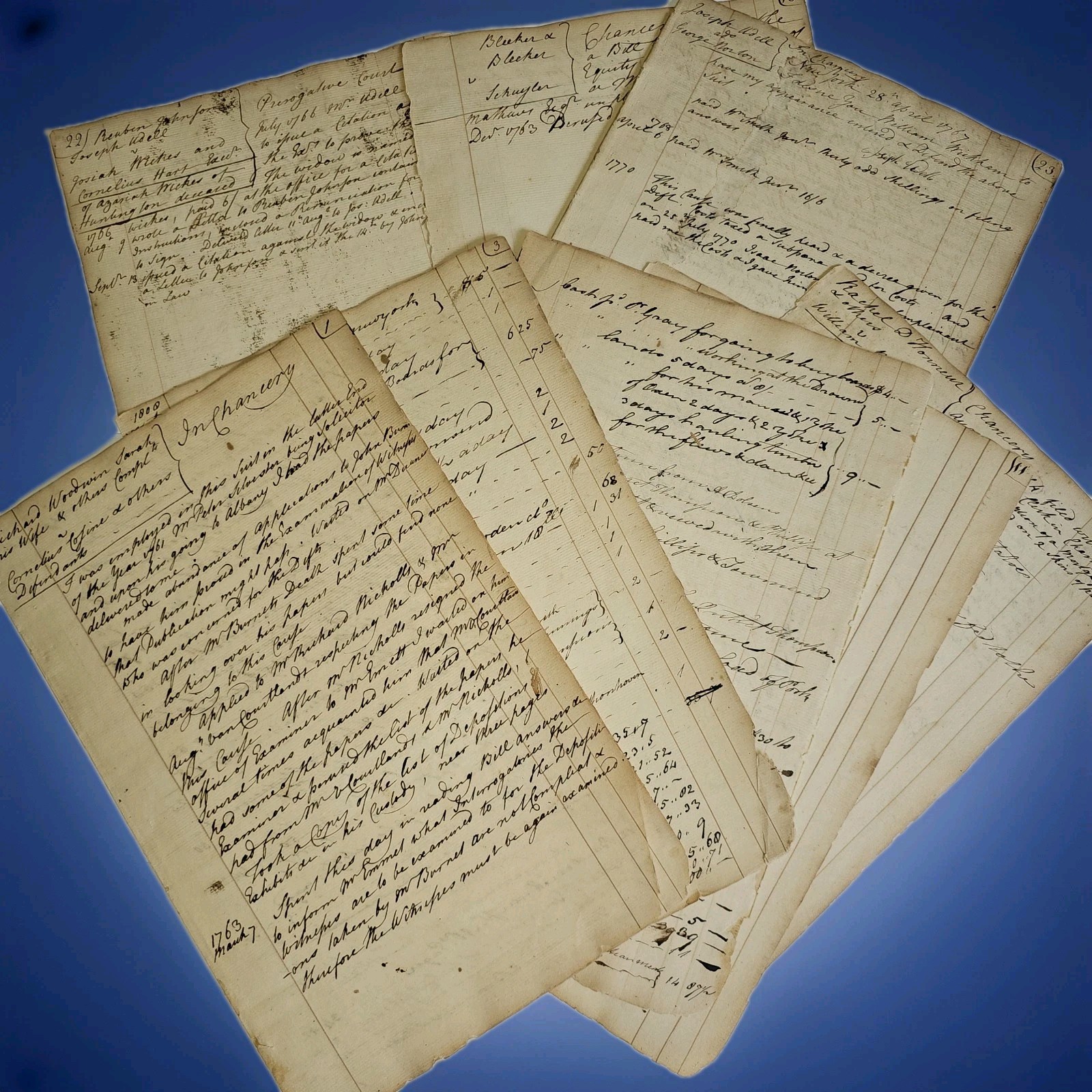
COLONIAL NEW YORK ATTORNEY'S DOCKET BOOK, c. 1763–1774Likely by William Smith Jr. (1728–1793)Chancery & Prerogative Court Manuscript on Pro Patria Watermarked PaperReferences to James Duane, Van Cortlandt, Woodhull, Brinckerhoff, Denton, Leake, Udall & Other Prominent Colonial Families
Offered here is an extraordinary colonial American legal manuscript consisting of approximately 30 surviving pages from what appears to have been a working attorney's docket and memorandum book used in New York between 1763 and March 1774, with later reuse around 1800–1802 as a farm and business ledger.
Based upon the legal content, repeated references to William Smith, the nature of the cases, the courts involved, and the prominent New York families represented throughout, this manuscript was likely created by William Smith Jr. (1728–1793), one of the most influential attorneys in colonial America and later Chief Justice of New York.
The volume spans the final decade of British civil administration in New York, ending only months before the First Continental Congress and the onset of the American Revolution. As such, it provides a remarkable snapshot of legal practice in one of Britain's most important North American colonies immediately before the collapse of imperial authority.
HIGHLIGHTS• Approx. 30 surviving manuscript pages
• Legal entries dating from 1763 through March 1774
• Later reused as a ledger c.1800–1802
• Written on period Dutch "Pro Patria" watermark paper
• Court of Chancery proceedings
• Prerogative Court (probate and estate matters)
• References to William Smith
• References to James Duane
• Prominent New York families represented
• Strong pre-Revolutionary historical context
WILLIAM SMITH JR. (1728–1793)The central figure connected to this manuscript is almost certainly William Smith Jr., one of the foremost attorneys and legal scholars in colonial New York.
Born in New York City in 1728, Smith was admitted to the bar in 1750 and quickly rose to prominence through his chancery and estate practice. He became one of the colony's most respected legal minds, representing many of New York's leading landowning and political families.
Smith authored the landmark work The History of the Province of New-York, served on the Governor's Council, and ultimately became Chief Justice of New York under British administration. Following the Revolution, he was appointed Chief Justice of Quebec.
His influence extended throughout the legal, political, and intellectual life of colonial America. Few attorneys of the era were more connected to the elite families whose names appear throughout this manuscript.
While no direct ownership statement survives, the repeated references to William Smith, combined with the nature of the cases and clientele, strongly suggest the manuscript originated within Smith's office or immediate professional circle.
JAMES DUANE (1733–1797)The manuscript contains references to James Duane, one of the most important figures in Revolutionary-era New York.
Duane was a distinguished attorney, delegate to the Continental Congress, signer of the Articles of Confederation, and later the first Mayor of New York City under the Constitution.
His appearance in the volume places the manuscript directly within the legal and political networks that would shape the emerging United States.
IMPORTANT FAMILIES APPEARING IN THE MANUSCRIPTVan Cortlandt FamilyAmong the wealthiest and most influential families in colonial New York. Their vast landholdings stretched throughout the Hudson Valley. Pierre Van Cortlandt became New York's first Lieutenant Governor and served throughout the Revolutionary era.
Woodhull FamilyA prominent Long Island family whose most famous member, General Nathaniel Woodhull, served as President of the New York Provincial Congress and died from wounds received after his capture by British forces in 1776.
Brinckerhoff FamilyOne of New York's oldest Dutch families, tracing its roots to New Amsterdam. Members served as merchants, landowners, public officials, and military officers throughout the colonial and early national periods.
Denton FamilyDescendants of Rev. Richard Denton, founder of Hempstead, Long Island. The Dentons remained active in landholding, law, and local government for generations.
Leake FamilyA significant colonial New York family involved in commerce, land ownership, and legal affairs throughout the eighteenth century.
Udall FamilyA notable Long Island family appearing frequently in colonial legal and estate records.
REPRESENTATIVE CASES & ENTRIESAmong the matters documented are:
Richard Woodwin & Wife vs. Cornelius Cline & OthersA Chancery proceeding involving depositions, examinations, and legal strategy.
Eldert Eldert & Hendrick Eldert vs. Joseph Barnet (1763)An early entry demonstrating active Chancery practice immediately following the French and Indian War.
Joseph Udall vs. Philip Udall & OthersAn estate and family dispute involving members of the prominent Udall family.
Alice Hopson & Others vs. Samuel HopsonA matter illustrating the role of Chancery in resolving family and inheritance disputes.
Probate & Estate MattersLater entries document proceedings before the Prerogative Court involving wills, estate administration, executors, citations, and property settlements.
One notable probate entry concerns Peter Ecker of Philipsburgh, Westchester County, whose estate involved executors Abraham Ecker and William Ecker, with references to witnesses and Surrogate procedures.
TIMELINE SIGNIFICANCEThe chronology of the manuscript is one of its most compelling features.
1763The legal portion begins shortly after the conclusion of the French and Indian War, when New York stood at the center of British North American commerce and governance.
1763–1774The manuscript records active legal work involving chancery cases, probate matters, attorney appearances, examinations, and court proceedings.
March 1774The legal entries conclude only months before the First Continental Congress and the rapid deterioration of British authority in the colonies.
This date is particularly significant. The manuscript effectively captures the final years of colonial legal administration before the Revolution transformed New York and the broader Atlantic world.
c.1800–1802Decades later, unused portions of the volume were repurposed as a ledger documenting:
• Livestock records
• Agricultural accounts
• Transportation of goods
• Timber, fish, pork, and other commodities
• Local financial transactions
This later use demonstrates the manuscript's survival through the Revolutionary era and provides a fascinating glimpse into everyday life in the Early Republic.
PRO PATRIA WATERMARKThe manuscript is written on high-quality Dutch laid paper bearing a strong "Pro Patria" watermark.
The watermark features the traditional Dutch lion and liberty imagery associated with imported paper widely used in official legal and governmental documents throughout colonial America.
The presence of this watermark confirms the period authenticity of the manuscript and its use within a professional legal setting.
CONDITIONApproximately 30 surviving pages.
Expected wear from use and age, including toning, edge wear, minor losses, staining, and handling marks.
Ink remains strong and highly legible throughout most entries.
The manuscript remains an exceptionally informative and visually appealing example of colonial legal record-keeping.
HISTORICAL IMPORTANCEThis manuscript bridges three distinct eras of American history:
The height of British colonial administration in New York.
The years immediately preceding the American Revolution.
The agricultural and commercial life of the Early Republic.
Likely originating within the professional orbit of William Smith Jr., it preserves a rare record of legal practice among some of the most influential families and attorneys of colonial New York.
A remarkable survival and an outstanding opportunity for collectors of colonial America, legal history, New York history, and eighteenth-century manuscripts.
1763-1774 Colonial NY Legal Ledger Manuscript Likely William Smith Jr., Duane:
$7500.00
Related Items:
1763-1774 Colonial NY Legal Ledger Manuscript Likely William Smith Jr., Duane
$7500.00