1530 King of Hungary Bohemia Ferdinand I Signed Royal Order to Austria Governors

When you click on links to various merchants on this site and make a purchase, this can result in this site earning a commission. Affiliate programs and affiliations include, but are not limited to, the eBay Partner Network.

1530 King of Hungary Bohemia Ferdinand I Signed Royal Order to Austria Governors:
$2337.46
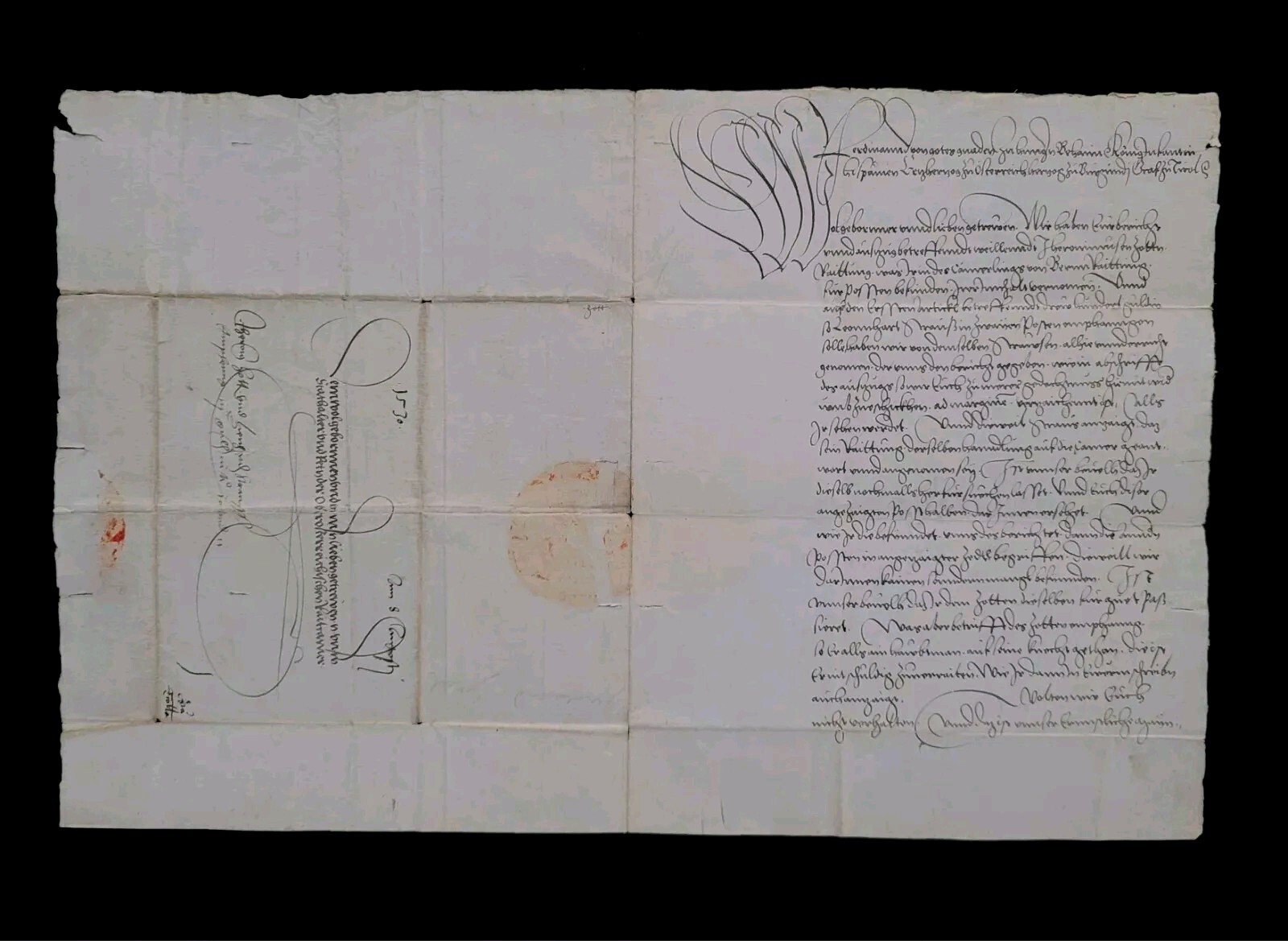
For your consideration is an original early sixteenth-century Habsburg administrative manuscript, issued under the authority of Ferdinand I of Habsburg (15031564), then reigning in his pre-imperial capacity as King of Hungary and Bohemia, and dated 8 June 1530. Executed in brown iron gall ink on a single folio of period laid rag paper measuring approximately 17 by 11.25 inches (43.2 28.6 cm), the document survives in its original folded bifolium format, creating four pages on a single leaf. The manuscript is written in an accomplished and controlled German Kanzleischrift hand and preserves the full material and administrative character expected of a genuine Habsburg state paper of this date. The opening titulature identifies Ferdinand in the formal dynastic style proper to the period, including his capacities as King of Hungary and Bohemia, Infante in Spain, Archduke of Austria, Duke of Burgundy, and Count of Tyrol, placing the document firmly within the political structure of the early Habsburg monarchy during the crucial years of consolidation following 1526 and prior to Ferdinands later elevation as Holy Roman Emperor in 1556.
The manuscript is of substantial physical and historical importance not merely because it bears the rulers autograph, but because it preserves the full bureaucratic architecture of an active state instrument. It was written on original period laid paper with visible chain lines and laid lines and bears, under transmitted light, a watermark in the form of a rampant lion, a papermakers device entirely consistent with Central European paper manufacture of the late fifteenth and early sixteenth centuries, particularly within Austrian, South German, or Tyrolean production networks that supplied Habsburg administrative centers. The paper, watermark, ink, hand, and format are internally coherent and fully appropriate to the date 1530. The sheet was folded for dispatch in the standard chancery manner, and the exterior panel preserves the address and filing structure that identify the document as an operational communication rather than a display charter or ceremonial patent. A circular remnant of the original red wax seal remains visible, confirming that the document was formally closed and authenticated at the time of issue, though the seal device itself is now largely lost.
The text is addressed to high-ranking governmental authorities and constitutes a formal royal administrative mandate directed to the Governor and Councillors of the Lower Austrian Government, that is, the Niedersterreichische Regierung, one of the central governing organs of the Habsburg hereditary lands headquartered in Vienna. The cover panel and address endorsement identify the recipients with precision, and the surviving endorsements on the signature page and exterior establish the documents movement through the Hofkanzlei, the Habsburg Court Chancellery. This combination of sovereign titulature, address, signature, seal remnant, chancery endorsements, docketing, and archival marks preserves the complete administrative lifecycle of the instrument: it was drafted, authorized, signed, , addressed, dispatched, processed, registered, and preserved. Such structural completeness materially enhances the scholarly and collecting importance of the piece, since it survives not simply as an isolated signed leaf but as a fully contextualized document of governance.
The most important authenticating feature is the large autograph subscription Ferdinandt, written boldly with characteristic calligraphic flourish and accompanied by formal validating language equivalent to a manu propria authentication, confirming execution in the sovereigns own hand. Additional endorsements on the signature page include a Latin-German formula identifying the ruler as Ferdinandus von Gottes gnaden, Rex, together with the hand of a secondary chancery official and related docketing notations, including the year 1530. These inscriptions are of particular importance because they demonstrate that the manuscript was not merely issued in Ferdinands name by officials, but was personally subscribed and administratively processed within the formal structures of Habsburg rule. The result is a document that unites autograph authority with institutional procedure, an especially desirable combination for collectors, museums, and scholars concerned with the mechanics of early modern monarchy.
In substance, the document conveys a clear and serious act of royal governance. It records that matters had been reported to Ferdinand and to his trusted officials concerning certain jurisdictions and the proper execution of duties owed to the crown. Having been informed of these developments, Ferdinand states that he has reviewed the matter and resolved upon a course of action. He orders that proper order be maintained henceforth, that royal service be correctly performed, that obedience to authority be preserved, and that disorder or deviation be prevented. The directive is thus not a grant of favor, a ceremonial proclamation, or a mere acknowledgment, but a binding order of administrative enforcement. It shows the sovereign responding to reported irregularities and instructing the central Lower Austrian governing council to ensure that the prescribed regulations and obligations are observed hereafter and at all times. In practical terms, this is a royal enforcement order correcting administrative disorder and commanding strict adherence to Habsburg governance.
A precise summary of what the document is conveying may therefore be stated as follows: a problem, irregularity, or disorder had been reported to Ferdinand by his officials concerning certain places and the services owed within them; Ferdinand acknowledges having received and considered those reports; he then orders that proper order and obedience be maintained going forward; and he directs the Governor and Councillors of the Lower Austrian Government to enforce compliance under his sovereign authority. The phraseology of the text culminates in the formula of his ernstlicher Wille, his earnest will, making clear that this was not advisory language but a direct and binding expression of royal intent. Historically, the manuscript is valuable because it provides a direct illustration of how Ferdinands government operated in practice: information rose through official channels, the sovereign responded, and the decision was transmitted through chancery mechanisms to the central regional governing body charged with implementation.
The document may be read in diplomatic English rendering as follows: Ferdinand, by the grace of God King of Hungary and Bohemia, Infante in Spain, Archduke of Austria, Duke of Burgundy, Count of Tyrol, to the well-born, our dear and faithful [servants]: We make known and declare hereby that we have been informed, and our faithful officials have likewise reported to us, that certain matters have newly occurred, and that the same have been brought before us and made known to us, concerning our faithful [subjects] and other neighboring places situated within certain jurisdictions, and regarding the service owed therein, all pertaining to our service. Whereupon we have ordered and resolved that henceforth it shall be so maintained, and shall stand in our obedience and without harm, as is necessary. Likewise, that all disorder be prevented. And hereby we make known that this shall be observed and accepted according to our command, that they shall perform and carry this out in all things hereafter and at all times. And in order that they may be held to this and understand our earnest intent, it is hereby commanded to our faithful officials and to the same that they conduct themselves herein and act as is proper. Accordingly, this is our earnest will, and that all this be done accordingly. Given on the 8th day of June. [Signed] Ferdinand, in his own hand. The exterior address is rendered as: To the well-born, our dear and faithful Governor and Councillors of the Lower Austrian Government. The related chancery endorsement identifies the document as having passed through the Hofkanzlei, while the surviving seal remnant confirms its formal execution and dispatch.
As an artifact, the manuscript is especially compelling because it is not dependent on a single element for its importance. Its value lies in the convergence of all its surviving features: period laid paper, rampant lion watermark, original folded format, precise date of 8 June 1530, formal Habsburg titulature, substantive administrative content, autograph royal signature, chancery endorsements, address to the Lower Austrian Government, and remnant of the original wax seal. Each of these features reinforces the others. Together they establish the piece as a materially coherent and historically significant document of early Habsburg administration, produced at a moment when Ferdinand was consolidating royal authority across his hereditary and newly acquired dominions. The survival of so many procedural and physical elements in one document gives it exceptional documentary integrity and makes it a particularly strong example of authentic sixteenth-century statecraft in manuscript form.
In its entirety, this is a rare and important Habsburg royal administrative order issued at a formative moment in Central European governance. It provides a direct, tangible witness to the exercise of sovereign power by Ferdinand I before his imperial accession, and it does so not abstractly, but through the precise machinery of government: report, review, decision, command, authentication, and enforcement. For the modern reader, it offers both a visually impressive survival of sixteenth-century chancery production and a substantive record of how authority was articulated and transmitted within the Habsburg state. Preserved with its autograph subscription, endorsements, watermark, original folded structure, and wax seal remnant, it stands as a museum-grade example of an early modern royal document in which material evidence, administrative function, and historical significance are all unusually well aligned.
1530 King of Hungary Bohemia Ferdinand I Signed Royal Order to Austria Governors:
$2337.46
Related Items:
1530 King Ferdinand I Habsburg Signed Royal Mandate Order Decree Dispute Hungary
$2775.00

PC ERNEST IBBETSON ARTIST GALE 39 THE KING'S OWN MILITARY POSTCARD (u1530)
$13.84

VINTAGE SACRAMENTO KINGS KFBK AM 1530 YOUVE NEVER HAD SO MUCH FUN 11.5x3 STICKER
$14.99