VERY RARE Ancient Roman Cosmic Bronze Ring of "Julius Caesar's Comet" in 44 BC

When you click on links to various merchants on this site and make a purchase, this can result in this site earning a commission. Affiliate programs and affiliations include, but are not limited to, the eBay Partner Network.

VERY RARE Ancient Roman Cosmic Bronze Ring of "Julius Caesar's Comet" in 44 BC:
$4475.00
ANCIENT CIVILIZATIONS
Artifacts, Antiques & Fine Collectibles
Ancient Roman Bronze Ring Honoring “Julius Caesar’s Comet”
& “The Great Comet of 44 BC”
circa 44 BC—30 BC
"... A comet shone for seven successive days, risingabout the eleventh hour,
and was believed to be the soul of Caesar."
~Roman Historian Suetonius, 44 BC
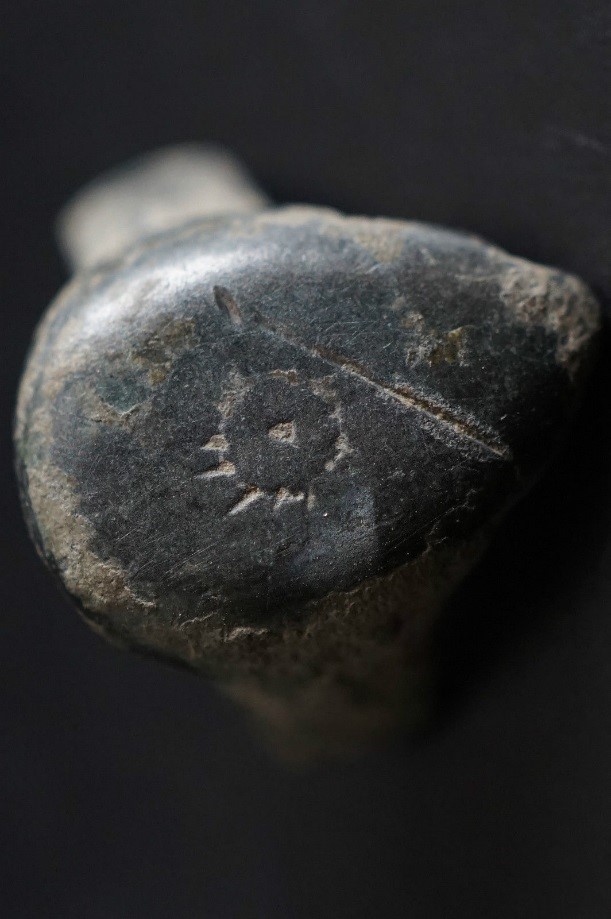
This RARE and unique Roman bronze ring represents a cometthat was visible four months after the assassination of Julius Caesar as hewalked to the Roman Senate on March 15, 44 BC.It has an image of the Sun engraved in the center with the Sun's rayssurrounding it, with a single line above the Sun that symbolizing the tail ofthe comet and a small mark to delineate the comet. The ring’s face even has the “tear-drop”shape of a comet that measures about 13.62 mm long x 10.68 wide! AMAZING!
This ring fragment weighs only about 3 grams and as you cansee in the photo # 7, is missing about one-half of the ring’s band due to anancient break. It is a museum qualityitem that is for display only.
This ring was a recent metal detector find in England and waslikely owned by a Roman soldier or statesman that was loyal to Caesar and tohis heir, Augustus Caesar. This is thefirst time it has been documented as a ring honoring Julius Caesar’s Comet andoffered to collectors and museums for private sale. This Julius Caesar Comet ring is extremelyunique and is one of only a few such items that remain in existence. It is incredibly RARE and HighlyCollectible!
Many Romans believed that the appearance of this brilliantcomet four months after Caesar’s assassination was a cosmic sign from the godsthat his soul had entered into the Heavens.For decades after its appearance, Caesar’s adopted son and heir,Augustus Caesar, used the appearance of this comet as a propaganda tool toregain power. Augustus was able toestablish his authority, dispense with the conspirators, and then—patiently andruthlessly—assume total control of the vast Rome Empire. Octavian eventually renamed himself AugustusCaesar and had a coin struck in 19 B.C. with his likeness on one side and thegreat comet on the other.
Thus, Caesar’s Comet has long been attributed to thesuccessful reign of Augustus and his descendants. This ring is unique in documenting just howfar the “Cult of Caesar” extended—to the Eastern edge of the Roman Empire--Britain.
Brief History of “Caesar’s Comet”
“Caesar's Comet” (numerical designation C/-43 K1) – alsoknown as “Comet Caesar” and the “Great Comet of 44 BC” – was perhaps the mostfamous comet of antiquity. The seven-day visitation was interpreted by Romansas a sign of the deification of recently assassinated emperor, Julius Caesar(100 BC–44 BC), who died on March 15, 44 BC during the Ides of March.
Caesar's Comet was known to ancient writers as the SidusIulium ("Julian Star") or Caesaris astrum ("Star ofCaesar"). The bright,daylight-visible comet appeared suddenly during the festival known as the LudiVictoriae Caesaris.
Ancient stargazers recorded the appearance of dozens ofbright comets. These visiting “stars”,which appeared out of nowhere and caused widespread terror, were often taken asomens and signs of doom or great change.So it was a great historical coincidence that one of the brightestcomets in recorded history marked a truly traumatic event– the death of one ofthe most important statesmen in history, Julius Caesar, in 44 B.C.
Modern research has confirmed that the comet appeared inlate July 44 BC, some four months after the assassination of Julius Caesar, aswell as Caesar's own birth month. According to Suetonius, as celebrations weregetting underway, "... A comet shone for seven successive days, risingabout the eleventh hour, and was believed to be the soul of Caesar."
Caesar was immensely popular with the common people ofRome. So his death was marked by anear-riotous funeral with stirring speeches and a public cremation. It was followed four months later bytraditional funeral games, the Ludi Victoriae Caesaris. During these games, in late July 44 B.C., ashockingly bright comet appeared in the heavens. According to the Roman historian Suetonius,as celebrations commenced, “...a comet shone for seven successive days, risingabout the eleventh hour, and was believed to be the soul of Caesar.”
Current research suggests that Caesar's Comet was one ofonly five comets known to have had a negative absolute magnitude and may havebeen the brightest daylight comet in recorded history. It was not periodic and may have disintegrated.
This awed many common Roman citizens. Caesar himself claimed divine status and hisfamily claimed lineage to Aeneus, the legendary founder of Rome, and to thegoddess Venus herself. So theappearance of a brilliant comet in the heavens was unnerving for all, andespecially for Brutus, Cassius, and the other senatorial conspirators whomurdered the great Caesar.
It was also a great propaganda tool for Caesar’s heir andadopted nephew Octavian. Octavian setabout, over the next thirteen years, establishing his authority, dispensingwith the conspirators and then, patiently and ruthlessly, assuming totalcontrol of Rome. Octavian eventuallyrenamed himself Augustus Caesar and had a coin struck in 19 B.C. with his likenesson one side and the great comet on the other.
The Comet became a powerful symbol in the politicalpropaganda that launched the career of Caesar's great-nephew (and adoptive son)Augustus. The Temple of Divus Iulius (Temple of the Deified Julius) was built(42 BC) and dedicated (29 BC) by Augustus for purposes of fostering a"Cult of the Comet". (It was also known as the "Temple of theComet Star".) At the back of the temple a huge image of Caesar was erectedand, according to Ovid, a flaming comet was affixed to its forehead.
The Star of Caesar in Literature
The poet Virgil writes in his ninth eclogue that the star ofCaesar has appeared to gladden the fields.Virgil later writes of the period following Julius Caesar’sassassination, “Never did fearsome comets so often blaze.” Gurval interestingly points out that thispassage in no way links a comet to Caesar’s divine status, but rather linkscomets to his death.
It is Ovid, however, who makes the final assertion of thecomet’s role in Julius Caesar’s deification. Ovid describes the deification ofCaesar in Metamorphoses (8 AD):
Then Jupiter, the Father, spoke..."Take up Caesar’sspirit from his murdered corpse, and change it into a star, so that the deifiedJulius may always look down from his high temple on our Capitol andforum." He had barely finished, when gentle Venus stood in the midst ofthe Senate, seen by no one, and took up the newly freed spirit of her Caesarfrom his body, and preventing it from vanishing into the air, carried ittowards the glorious stars. As she carried it, she felt it glow and take fire,and loosed it from her breast: it climbed higher than the moon, and drawingbehind it a fiery tail, shone as a star.
It has been argued recently that the idea of Augustus's useof the comet for his political aims largely stems from this passage.
In Shakespeare’s Julius Caesar (1599), Caesar's wife remarkson the fateful morning of her husband's murder: "When beggars die thereare no comets seen. The heavens themselves blaze forth the death ofprinces."
A Piece of Heaven
Having fought his way into power, Augustus used religion asa tool to protect his position and promote his political agenda.
Having gained power by force in a bitterly fought civil war,Augustus was aware that he could easily lose it again. He was prepared to useany tool at his disposal to strengthen his claim to the imperial throne andthereby make it harder for his enemies to overthrow him.
An important part of this strategy involved religion. TheEmperor of Rome was already the most powerful man on earth, but this wasn’tenough. Augustus wanted a piece of heaven too: he was determined that hispeople would see him as their supreme spiritual leader.
Roman religion had many gods and spirits and Augustus waskeen to join their number as a god himself. This was not unusual: turningpolitical leaders into gods was an old tradition around the Mediterranean.There was also precedent in Roman history – Aeneas and Romulus, who had helpedfound Rome, were already worshipped as gods.
Halley’s Comet
Aside from their many gods, Romans were deeplysuperstitious, so when Augustus was handed a huge piece of luck, he took fulladvantage of it.
Early in his reign, Halley’s Comet passed over Rome.Augustus claimed it was the spirit of Julius Caesar entering heaven. If Caesarwas a god then, as his heir, Augustus was the son of a god and he made surethat everybody knew it.
Now regarded as part-god, Augustus encouraged stories of hisfrugal habits. He let people know that he lived in a modest house, slept on alow bed and, when he wasn’t fasting, ate only very plain food, like coarsebread and cheese. In a letter, he boasted to his stepson, Tiberius, of how hehad not eaten all day.
Traditional values
Promoting himself as the man who would return Rome’s pastglory, Augustus claimed that only by restoring the traditional values that hadfirst made Rome great could he hope to make it great again. One writercommented: ‘He renewed many traditions which were fading in our age andrestored 82 temples of the gods neglecting none that required repair at thetime.’
As ruler of Rome, Augustus had to lead by example. Here-established traditional social rules and religious rituals, sacrificinganimals to Rome’s gods. In 12 AD, he made himself Pontifex Maximus, the chiefpriest of Rome and head of the Collegium Pontificum, the highest priests in theland.
These initiatives were very popular. To many Romans, thereign of Augustus marked the point at which Rome had rediscovered its truecalling. They believed that, under his rule and with his dynasty, they had theleadership to get there. At his death, Augustus, the ‘son of a god’, washimself declared a god. His strategy had worked.
BRONZE Facts
Museums and modern archaeological studies usually use thegeneral term “copper alloy” instead of just the term “bronze” to describe theseancient treasures, as many other elements (such as tin, lead, zinc, iron, andeven arsenic) were added to the copper to form different strengths of types ofbronze items. Ancient bronze artifacts such as this ring are probably about 75%copper and 25% tin, while modern bronze is closer to 88% copper and 12% tin.
This historic ring has a beautiful, old patina with some signsof oxidation of the two main elements (tin and copper) that make up thisexquisite bracelet. One interesting property of bronze is that once it hasoxidized superficially, a copper oxide layer is formed on the surface andessentially protects the object from further damaging corrosion. Thisprotective layer turns in another compound, called copper carbonate for youscientists, that protects most bronze pieces from even corrosivesaltwater.
I have carefully examined this ring under 10x magnification,and it also shows authentic and original signs of weathering and ground contactthat help to further authenticate it as an ancient piece.
Please examine the photos taken indoors carefully as theyare part of the description.
The wood stand and coin are not part of the sale, justthere to give you a perspective.
And please ask any questions before you buy.
I offer a full Money-Back Guarantee if a recognizedauthority disputes the authenticity of this object.
Note: Please ask anyquestions you may have before you offer!Thanks for Looking!
Per 's rules, PayPal only please!
VERY RARE Ancient Roman Cosmic Bronze Ring of "Julius Caesar's Comet" in 44 BC:
$4475.00
Related Items:

PSA 10 Breadbug Pikmin 2 E-Card No. 060. ONE OF A KIND. VERY SPECIAL. MEGA RARE.
$4200000.01
$1000000.00

Very Rare Albino White M&M Candy
$750000.00