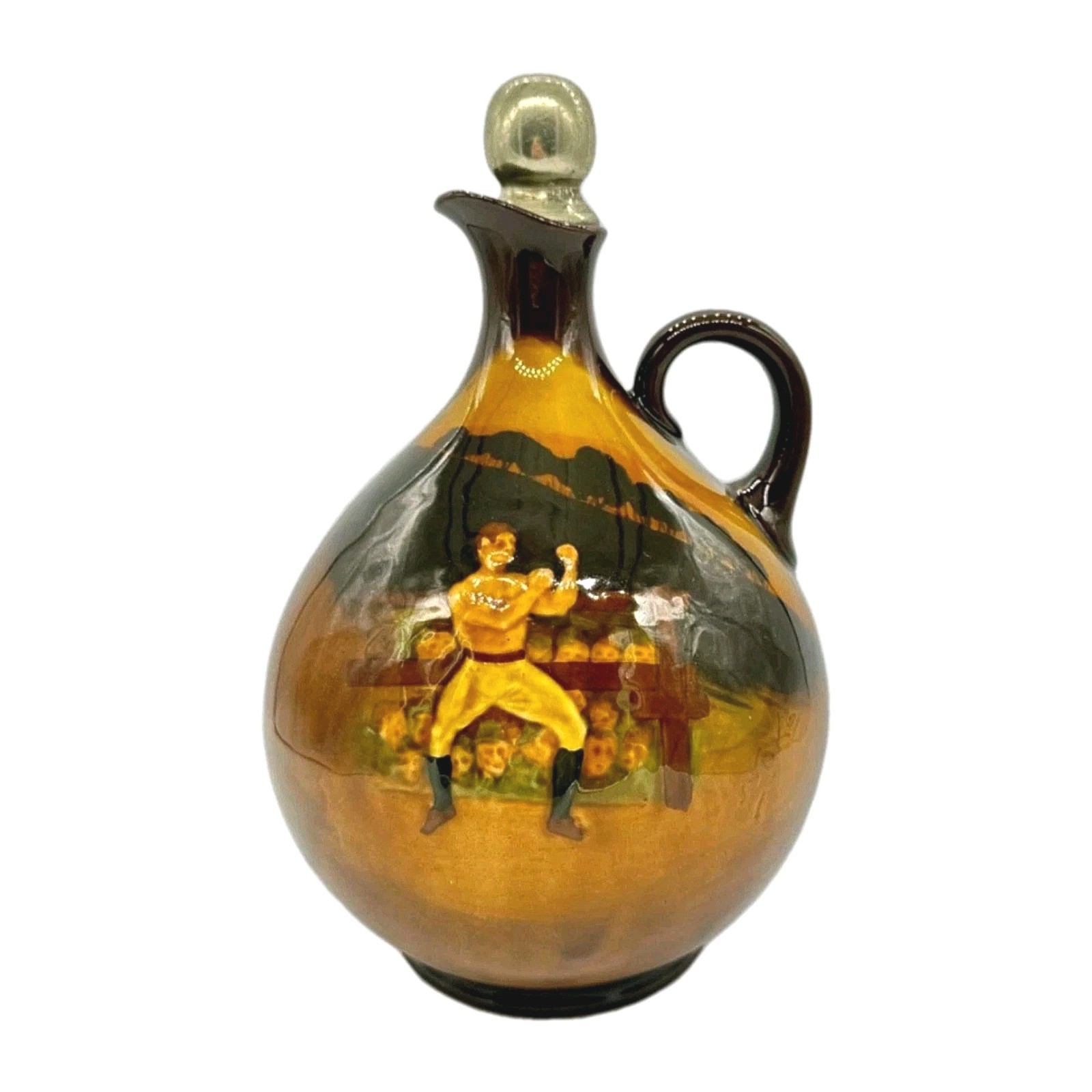
Rare Royal Doulton Daniel Mendoza Jewish Prizefighter Kingsware Whiskey Flask #3

When you click on links to various merchants on this site and make a purchase, this can result in this site earning a commission. Affiliate programs and affiliations include, but are not limited to, the eBay Partner Network.

Rare Royal Doulton Daniel Mendoza Jewish Prizefighter Kingsware Whiskey Flask #3:
$12000.00
Description.
🍁This sale Sale is For One Rare Version #3,Royal Doulton Daniel Mendoza Jewish Prizefighter Kingsware Whiskey Flask Decanter Bottle JugOnly!
The Flask Comes in 4 Versions Hand Painted by One or More Different Royal Doulton Artists. Designed ByCharles Noke That was Royal Doultons Premier Designer and Modeller.
The Flask Stands 7.5 Inches Tall and Incised " MENDOZA " on The Back. Incised on The Front Near The Bottom is " Noke " Doultons Design Artist.
Excellent condition with no chips, cracks, or Restorations.
This Antique Flask is Over 100 Years Old and is Duty Free To The USA.Everything Made in USA, Shipped to USA is Duty Free.Customs Code9706 000000
Combined Shipping Available!
Daniel Mendoza engraving by Charles Jean Robineau, mezzotint by Henry Kingsbury (1789)
From Wikipedia, the free encyclopediaPersonal informationNickname(s)Mendoza the Jew
The Star of IsraelNationalityEnglishBorn5 July 1765London, EnglandDied3 September 1836(aged72)London, EnglandHeight5ft 7in (1.70m)Weight160lb (73kg)Boxing careerStanceOrthodoxBoxing Mendoza(5 July 1765– 3 September 1836), often known asDan Mendoza, was an English boxer, who was a popular prizefighter in late 18th-century Britain. He played a significant role in advancing the scientific technique in boxing by publishing two books on the subject (The Art of BoxingandThe Modern Art of Boxing) and by conducting frequent public exhibitions.While modern sources often portray Mendoza as the English Prizefighting Champion from 1792 to 1795, contemporary sources from the late 18th and early 19th century do not describe Mendoza in this manner.Early life and ancestryMendoza was born in theWhitechapelarea ofLondonon 5 July 1764, toSephardic Jewishparents Abraham Aaron Mendoza and Esther Lopez.By the time he was born, Jews had been allowed to settle in England for about one hundred years, having been readmitted officially byCromwellin 1656. They were still regarded by many Londoners with a degree of suspicion and faced significantantisemitism. Mendoza's ancestors came from theKingdom of Jaén(in present-dayAndalusia, Spain); they had emigrated to theNetherlands, which had a policy of toleration, where his grandfather was born. The family moved to London, with ancestors living there for a century before Mendoza's birth. Several sources wrote that some of his London ancestors from Spain had earlier concealed their Jewish identity and converted to Christianity, becomingMarranos. According to many genealogical websites, his parents were and were believed to be artisans by trade. Jewish scholar Albert Hyamson wrote that Aaron Mendoza, ashochetwho had written a book on his craft in 1773, was his grandfather.Mendoza attended a Jewish school, Shaare Tikvah,where he was instructed in English grammar, writing and arithmetic, as well as Hebrew.He grew up inLondon's East Endin poor surroundings and worked as a glass cutter, labourer, assistant to a green grocer, and actor before taking up boxing as a profession.Early career highlights 1780–90Mendoza's first fight occurred in 1780 when he was 16. At the time, he was working for a tea dealer inAldgate. The fight was not a prize fight for a purse, but a contest to settle a dispute with a porter over payment for a consignment of tea. The porter had demanded twice the agreed price for the consignment and Mendoza said the porter behaved in a manner unfit for a gentleman. After much arguing between the porter and the proprietor of the tea dealership, the porter challenged the owner to settle the dispute by a duel with fists.Believing the porter was cheating his frail employer, Mendoza accepted the challenge on his behalf. Richard Humphries acted as Mendoza's second. Humphries would later act as a manager for Mendoza, arranging training facilities and securing payment for fights.The duel with the porter took place in the street outside the tea dealership in a hastily constructed ring. The fight lasted for forty-five minutes, ending when the porter declared he was unable to continue. This victory brought a small measure of fame to Mendoza, as stories of the fight spread through the surrounding neighborhoods and portrayed Mendoza as the talented whippersnapper who had not just beaten, but thrashed his larger opponent.Bout with Harry the Coalheaver, 1784Turning professional at 18, Mendoza fought atMile Endin 1784 against Harry the Coalheaver. After 40 rounds, lasting 118 minutes, Mendoza brought the larger man into submission.Bouts with Tom Tyne, 1785 and 1786Mendoza then fought Tom Tyne, a tailor fromBermondsey. The exact date of this fight is unclear. Mendoza himself claims 1783but other events in the narrative of his autobiography suggest a date closer to 1786/7. Wheldon (2019)otes that a report in thePublic Advertiserseems to set the date accurately at 7 November 1785. The report read as follows: 'Monday, a pitched battle was fought nearWanstead, between Mendoza, the noted fighting Jew, and a tailor, of theBorough, which after a contest of 40 minutes (during which time much real drubbing was given on both sides) was decided in favour of the tailor, to the no small disappointment and regret of the knowing ones'.On July 1786 Mendoza fought a rematch against Tyne atDuppas Hill,Croydon, having dispatched a couple of minor fighters in the intervening eight months. The second bout vs Tyne resulted in victory for Mendoza in a fight lasting 27 rounds and almost an hour. Mendoza noted that in the second bout Tyne fought with 'uncommon shyness' and that 'several sporting gentlemen assembled on this occasion'.Bout with Sam Martin, 1787After his fight with Sam Martin the Bath Butcher in Barnet on 17 April 1787, which Mendoza won in ten rounds and a total of 26 minutes, he was transported home followed by a cheering crowd who carried lighted torches and sang 'See the Conquering Hero Comes'.After the fight, the Prince of Wales, who would become KingGeorge IV, presented Mendoza with 500 pounds, in addition to the 500 pounds he had won in the match, and shook his hand in full view of the gallery. Mendoza used the money to open a boxing school in Capel Court. The recognition by royalty annoyed his second, occasional manager Richard Humphries, who became a rival and planned for a match, but it elevated the stature of Jews in London.With the money he won from the Martin fight, Mendoza is believed to have married first cousin Esther Mendoza around 1789. They would have eleven children, whom Mendoza later struggled to support. Before he married, he promised Esther to quit boxing, but was unable to keep his promise.
Charles Noke was Royal Doultons premier designer and modeller.
Here we examine why and Charles Noke's life, his work, the Doulton relationship and his history.
In 1899 the Doulton studio recruited a young designer by the name of Charles Noke.
He is now regarded as the brainchild behind Royal Doulton Seriesware, a range of products were standard blank pottery shapes (everything from plates to jugs, bowls to vases and teapots) could be decorated with a consistent theme.
Royal Doultons Charles Noke
Initially, Charles John Noke was a gifted ceramic designer at the Royal Worcester factory and only later became the senior designer and modeller for Royal Doulton from 1889.Our Story
In 1815 John Doulton didn't know he could move mountains. But he invested his life savings, £100, in a small London pottery operation. Call it luck, wisdom or business acumen, but from a maker of storage jars and ceramic sewage pipes grew a leader in design-driven, technically innovative manufacturer of fine tableware. Ours is a story of many firsts, from innovating new materials and glazing techniques, to collaborating from the beginning with artists and designers, and focusing on educating and empowering women. In the course of 200 years, our focus on bringing premium quality and exceptional design to everybody's table has been a resounding success. Earning us not one but two Royal Warrants, and the continuing love of fans the world over. And although city regulations pushed the Factory out of London in the late 1950s, London hasn't left Royal Doulton. Today, more than ever, we are firmly embedded in and draw our deepest inspiration from the stories and flavors of the village of our home town - London.
1815 John Doulton invests his life-savings of £100 in a pot-house in Lambeth, London. They produce drain pipes, pottery and storage jars.1835 John’s son Henry joins the business, paving the path to unprecedented success.1861 Following the passing of Prince Albert, Queen Victoria commissions Doulton to create a specially made set of water filters for all her castles and palaces.
1862 Doulton exhibited copies of the Queen's new water filters at the second Great Exhibition.1863 Employment of young London artists from the Lambeth School of Art begins, with results impressing art critics, the public and Queen Victoria.1877 Henry Doulton takes a share in an earthenware factory in Burslem, Stoke-on-Trent, the heart of ‘The Potteries’.
1880's The Lambeth Pottery employs over 200 artists and designers from the Art School, many of them women.1887 Henry Doulton becomes the first potter in history to be awarded the knighthood.1890's Major contribution to London’s architectural fittings, tiles and decoration on landmark buildings from Harrods Knightsbridge to Savoy and Selfridges.
1901 Royal Doulton is born after receiving a Royal Warrant, and permission to use the word ‘Royal’ in our name.1955 New City regulations prohibit salt glaze production, forcing closure of the Lambeth factory and transfer of all production to ‘The Potteries” in Stoke-on-Trent.
1960 New English Translucent China offers the qualities of fine bone china at a modest cost.1978 Original Doulton House tiles transferred to the Victoria and Albert Museum in London.2010's New brand direction embraces the urban culture and eclectic style of the city.2010's Collaborations with London designers, artists and craftsmen include Barber & Osgerby, Charlene Mullen, Pure Evil, Nick Walker and Gordon Ramsay.
2012 Launch of the 1815 collection spearheads our push to capture evolving dining trends and help reposition the brand.
2015 200 year anniversary2018 Our instagram community reaches 15,0002020 Renewed Royal Doulton brand launches2021 Olio by Barber Osgerby and Signature 1815 win multiple dinnerware awards.2022 We celebrate 10 joyful years of 1815 since launching the collection in 2012.
Rare Royal Doulton Daniel Mendoza Jewish Prizefighter Kingsware Whiskey Flask #3:
$12000.00
Related Items:

Rare 1269 Medieval Margraviate of Antwerp Royal Bronze Civic Seal Matrix Belgium
$75000.00
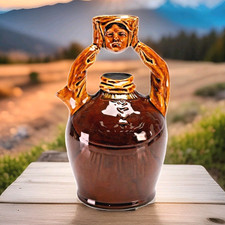
Rare Famous Royal Doulton Kingsware Whiskey Flask Jug The Quiet Woman, Prototype
$40000.00
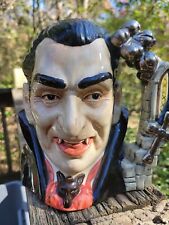
☆PROTOTYPE Royal Doulton Dracula D7053 Toby VERY RARE UNIQUE COLORWAY MUSEUM ART
$33996.96